
Contents
- Abstract:
- Original Link:
- Previous Recommendations:
- More exciting content is available here:
- Document Acquisition:
- Body Text
- 1. Basic Concepts of Thread Synchronization
- 2. Thread Data Synchronization Based on Mutex Locks
- 3. Thread Data Synchronization Based on Recursion Lock
- 4. Thread Data Synchronization Based on Semaphores
Abstract:
In Python multi-threaded programming, thread synchronization is a key technology to ensure that multiple threads access shared resources safely. This article introduces the concepts and applications of mutex locks (Lock), recursion locks (RLock) and semaphores (Semaphore). Mutex locks are used to prevent multiple threads from modifying data simultaneously, recursion locks are suitable for nested locking scenarios, while semaphores limit the number of threads that can access a resource at the same time.

For more information about us, you can refer to the cloud document: Freak Embedded Studio Cloud Docs, or visit our wiki: https://github.com/leezisheng/Doc/wik
Original Link:
Previous Recommendations:
You who are learning embedded systems, don’t you even know Object Oriented yet? ?!
Master Python Parallel Computing in One Article: 00 Basic Concepts of Parallel Computing
More exciting content is available here:
Speed Up Your Python: A Quick Guide to Python Parallel Computing
Understand the Debugging Principle of CM3 Microcontroller in One Article
The "Martial Arts Manual" for Computer Science Competitions
Avnet ZUBoard 1CG Development Board — A New Choice for Deep learning
What? A motor drive module with customizable color schemes? !
What? Three brand-new expansion boards have just been released for the XIAO main controller!
A Step-by-Step Guide to Publishing Your Third-Party Library for Arduino
Document Acquisition:
You can download the document via the following link:
https://github.com/leezisheng/Doc
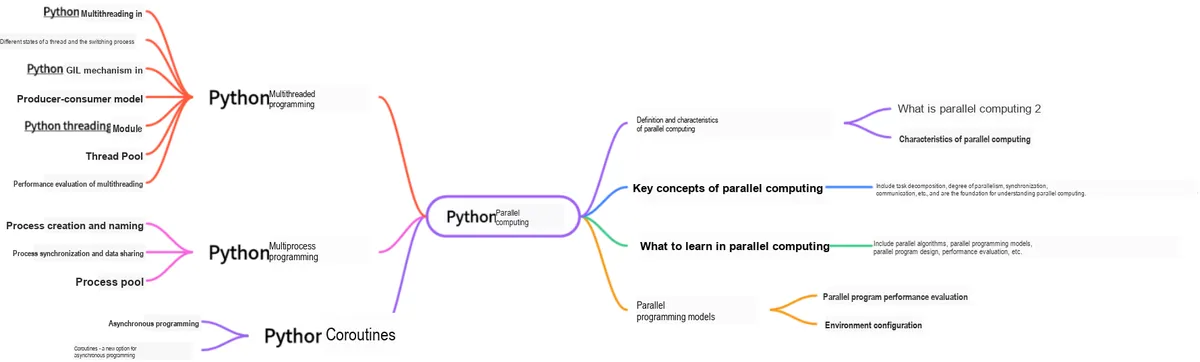
This document is a learning guide on parallel computing and Python concurrent programming, which covers the core knowledge points including the basic concepts of parallel computing, Python multi-threaded programming, multi-process programming and coroutine programming:
Body Text
1. Basic Concepts of Thread Synchronization
In Python multithreaded programming, thread synchronization is a mechanism that ensures multiple threads can safely access shared resources. In a multithreaded environment, if multiple threads access and modify shared resources simultaneously, issues such as race conditions and data inconsistency may occur. For example:
import threading

# Shared variable
counter = 0

def increment():
    global counter
    for _ in range(1000000):
        counter += 1

# Create two threads
t1 = threading.Thread(target=increment)
t2 = threading.Thread(target=increment)

# Start the threads
t1.start()
t2.start()

# Wait for the threads to finish
t1.join()
t2.join()

# Expected to be 2000000, but may be less than this value
print("Final Counter:", counter)
Since counter += 1 is not an atomic operation, but a three-step process of read -> compute -> write, two threads may read counter at the same time, causing partial data loss when writing. The final result may be less than 2000000, which is the so-called Race Condition.
Let's take another practical example: in the code below, we spawn 200 threads, and all of these 200 threads will access counter, this shared resource, and perform an operation on it (counter += 1). Let's take a look at the running result:
import threading
import time

counter = 0

class MyThread(threading.Thread):
    def __init__(self):
        threading.Thread.__init__(self)

    def run(self):
        global counter
        time.sleep(1);
        counter += 1
        print("I am %s, set counter:%s" % (self.name, counter))

if __name__ == "__main__":
    for i in range(0, 200):
        my_thread = MyThread()
        my_thread.start()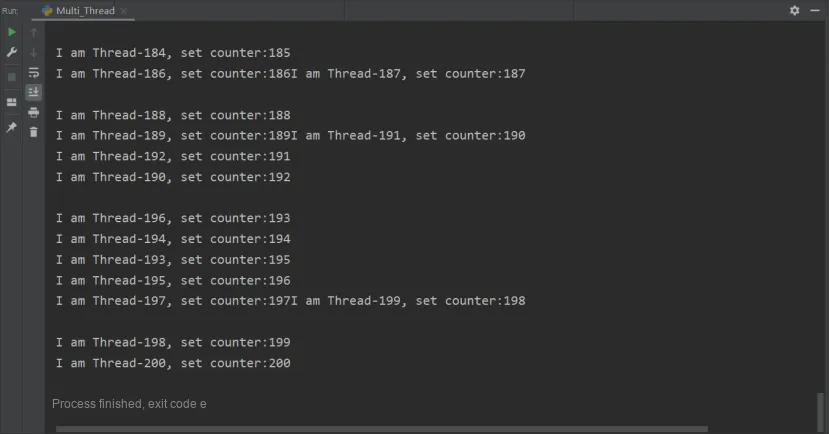
From this, we have already seen the preemption of this global resource (counter). The root cause of the problem is that there is no proper control over multiple threads accessing the same resource, which leads to data corruption and makes the execution results of threads unpredictable. This phenomenon is referred to as "thread-unsafe", and we must avoid such situations during the development process.
2. Thread Data Synchronization Based on Mutex Locks
The simplest solution to "thread-unsafe" issues is to use locks. The operation of a lock is straightforward: when a thread needs to access a segment of shared memory, it must first acquire the lock before gaining access. After the thread finishes using this portion of shared resources, it must release the lock, so that other threads can then acquire the lock and access the same resources.
In Python, we use the Lock class provided by the threading module to implement the mutex mechanism. To modify the above program, we need to add a lock variable mutex = threading.Lock (), then before competing for resources, we will first acquire this lock mutex. acquire (), and after finishing using the resource, we will release this lock mutex. release ().
The code is as follows:
import threading
import time

counter = 0
mutex = threading.Lock()

class MyThread(threading.Thread):
    def __init__(self):
        threading.Thread.__init__(self)

    def run(self):
        global counter, mutex
        time.sleep(1);
        if mutex.acquire():
            counter += 1
            print("I am %s, set counter:%s" % (self.name, counter))
            mutex.release()

if __name__ == "__main__":
    for i in range(0, 100):
        my_thread = MyThread()
        my_thread.start()
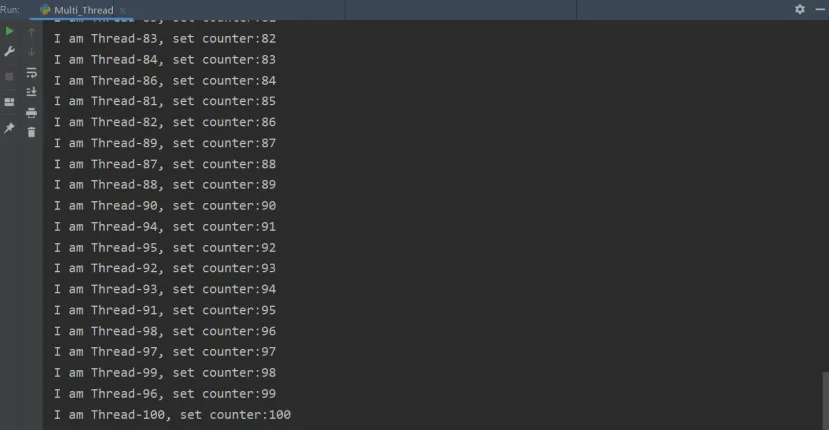
The output shown in the figure below indicates that the counter variable keeps incrementing, and the preemption issue of the global resource (counter) has been resolved. The main process is as follows: when a thread calls the Lock object's acquire () method to acquire the lock, the lock enters a "locked" state. Since only one thread (Thread 1) can acquire the lock at a time, if another thread (Thread 2) attempts to acquire this lock at this point, that thread (Thread 2) will enter a "block" synchronous blocking state.Until the thread that holds the lock, Thread 1, calls the lock's release () method to release the lock, the lock enters the "unlocked" state. The thread scheduler selects one of the threads in the synchronous blocking state to acquire the lock, and transitions this thread to the running state.
However, in practical use, we find that this method frequently gives rise to a problematic deadlock situation. A deadlock occurs when different threads attempt to acquire a lock, at which point the program can no longer proceed with execution, as each thread holds the lock that the other requires.
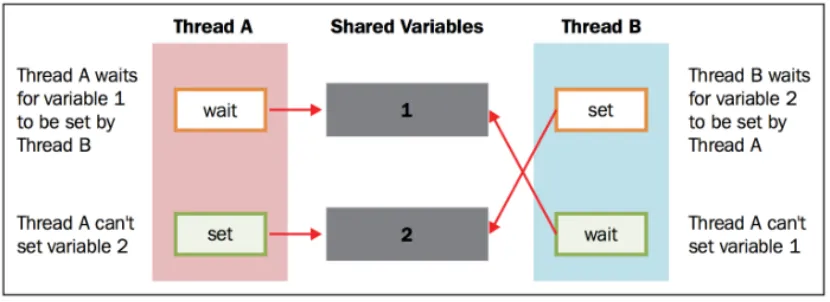
To simplify the problem, let us assume that there are two concurrent threads (Thread A and Thread B) that require Resource 1 and Resource 2. Suppose Thread A needs Resource 1, and Thread B needs Resource 2. In this scenario, both threads are using their respective locks, and there is no conflict so far. Now suppose that before either side releases its lock, Thread A requests the lock for Resource 2, and Thread B requests the lock for Resource 1; neither thread will proceed without the required resource.Given that the locks of both resources are currently occupied, and each side remains in a waiting state without releasing its own lock until the other side's lock is freed, this is a typical scenario of deadlock.
Let's look at the following code:
import threading

counterA = 0
counterB = 0

mutexA = threading.Lock()
mutexB = threading.Lock()

class MyThread(threading.Thread):
    def __init__(self):
        threading.Thread.__init__(self)

    def run(self):
        self.fun1()
        self.fun2()

    def fun1(self):
        global mutexA, mutexB
        if mutexA.acquire():
            print("I am %s , get res: %s" % (self.name, "ResA"))

            if mutexB.acquire():
                print("I am %s , get res: %s" % (self.name, "ResB"))
                mutexB.release()

        mutexA.release()

    def fun2(self):
        global mutexA, mutexB
        if mutexB.acquire():
            print("I am %s , get res: %s" % (self.name, "ResB"))

            if mutexA.acquire():
                print("I am %s , get res: %s" % (self.name, "ResA"))
                mutexA.release()

        mutexB.release()

if __name__ == "__main__":
    for i in range(0, 100):
        my_thread = MyThread()
        my_thread.start()
The code demonstrates that two function functions of a thread acquire another competing resource after having acquired one competing resource respectively. Let's look at the running result:
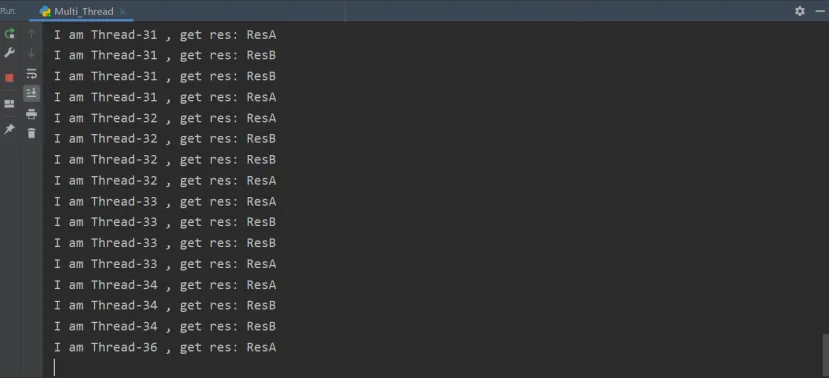
As you can see, the program has been suspended there, and this phenomenon is what we call a "deadlock". The main method to avoid deadlocks is to allocate resources correctly and in an orderly manner. The most representative algorithm in deadlock avoidance algorithms is the Banker's Algorithm proposed by Dijkstra E.W in 1968.
3. Thread Data Synchronization Based on Recursion Lock
Consider this scenario: what should a thread do when encountering lock nesting? Here, nesting refers to the situation where a thread, while already holding access to a critical resource, needs to acquire that same resource again. The corresponding code is as follows:
import threading
import time

counter = 0
mutex = threading.Lock()

class MyThread(threading.Thread):
    def __init__(self):
        threading.Thread.__init__(self)

    def run(self):
        global counter, mutex
        time.sleep(1);
        if mutex.acquire():
            counter += 1
            print("I am %s, set counter:%s" % (self.name, counter))
            if mutex.acquire():
                counter += 1
                print("I am %s, set counter:%s" % (self.name, counter))
                mutex.release()
            mutex.release()
if __name__ == "__main__":
    for i in range(0, 200):
        my_thread = MyThread()
        my_thread.start()
The code execution in this scenario is as follows: as can be seen, after a thread acquires the mutex once, it needs to use the critical variable counter again, so it attempts to acquire the mutex once more:

then it directly hangs, and this situation forms the simplest deadlock.
Is there a situation where a thread can access a competing resource using mutual exclusion and retrieve it again? In Python, to support multiple requests for the same resource in the same thread, Python provides a "reentrant lock": threading. RLock . This RLock maintains a Lock and a counter variable internally. Counter records the number of acquire , so that the resource can be required multiple times.Only when all the acquire operations of a thread have been release d can other threads acquire the resource. If we use RLock instead of Lock in the above example, no deadlock will occur:
The code only needs to implement the following:
mutex = threading.Lock()Replace with:
mutex = threading.RLock()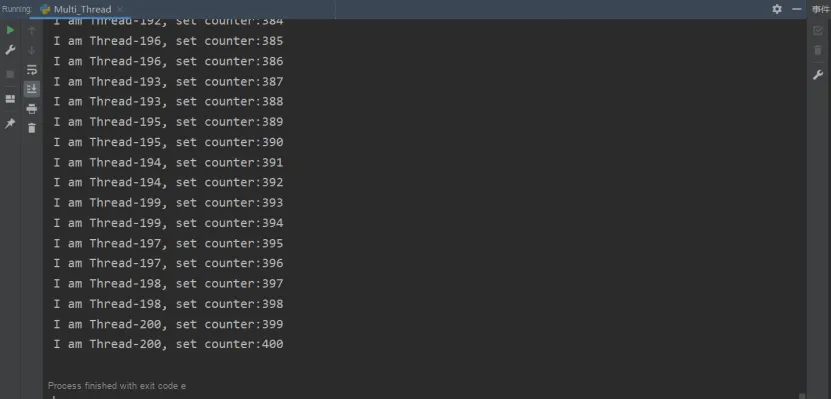
Compared with Lock, this lock has three characteristics:
- Whoever acquires the lock gets to release it. If thread A acquires the lock, thread B cannot release it — only thread A itself is authorized to do so;
- The same thread can acquire this lock multiple times, that is, it can
acquireit multiple times; acquireas many times as you must, and you must releasethe same number of times; only the final releasewill releaseand change the state ofRLocktounlocked.
Nested locks also have drawbacks, as they create complications for our lock detection mechanisms.
4. Thread Data Synchronization Based on Semaphores
Semaphores were invented by E. Dijkstra and first applied in operating systems. As an abstract data type managed by the operating system, semaphores are used to synchronize the access to shared resources among multiple threads. In essence, a semaphore is an internal data that indicates how many concurrent reads are allowed for the current shared resource.
Similarly, in the threading module, there are two functions for semaphore operations: acquire () and release (), which are explained as follows:
(1) Whenever a thread intends to read the shared resource associated with the semaphore, it must call acquire (). This operation decrements the internal variable of the semaphore; if the value of this variable is non-negative, the permission to allocate the resource is granted. If the value is negative, the thread is suspended until another thread releases the resource;
(2) When a thread no longer needs the shared resource, it must release the resource via release (). This increments the internal variable of the semaphore, and the thread at the head of the semaphore's waiting queue will obtain access to the shared resource.
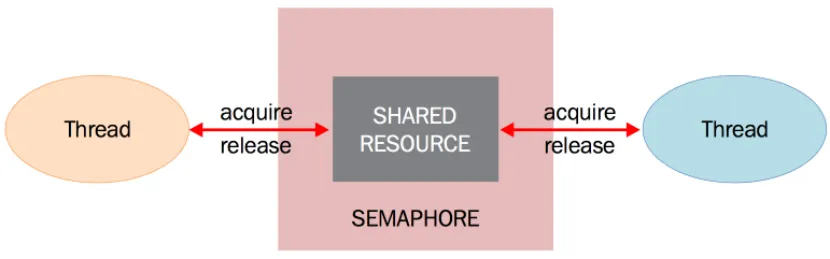
Generally speaking, to acquire a shared resource, a thread needs to perform the following operations:
- Test the semaphore that controls this resource.
- If the value of this semaphore is positive, the resource is allowed to be used, and the thread decrements the semaphore by 1.
- If the value of this semaphore is 0, the resource is currently unavailable, and the thread enters a sleeping state; it will not be woken up and transferred to step 1 until the semaphore value becomes greater than 0.
- When a thread no longer uses the resource controlled by a semaphore, the value of the semaphore is incremented by 1. If there is a thread sleeping and waiting for this semaphore at this time, wake up this thread.
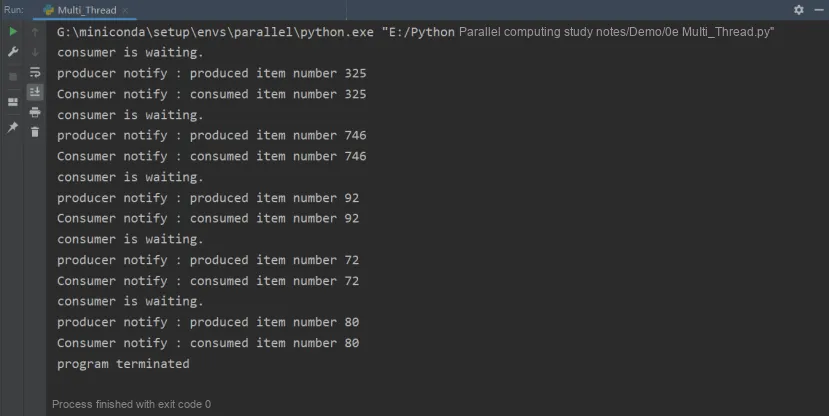
In the following code, we use the producer-consumer model to demonstrate synchronization via semaphores. We have two threads, producer () and consumer (), which share a common resource item. producer () is tasked with producing item, while consumer () is tasked with consuming item. When the item has not yet been produced, consumer () waits continuously; once the item is produced, the producer () thread notifies the consumer that the resource is available.
import threading
import time
import random

# By initializing the semaphore to 0, we get a so-called semaphore event
# The optional Semaphore argument gives the initial value of the internal variable, default 1.
# If the given value is less than 0, ValueError is raised.
semaphore = threading.Semaphore(0)

def consumer():
        print("consumer is waiting.")

        if semaphore.acquire():
                # If the consumer acquires the semaphore, i.e. the semaphore is greater than 0
                print("Consumer notify : consumed item number %s " % item)
        # If the consumer does not acquire the semaphore, i.e. the semaphore equals 0, the consumer thread blocks

def producer():
        global item
        time.sleep(1)

        item = random.randint(0, 1000)
        print("producer notify : produced item number %s" % item)
        #  Release the semaphore to notify the consumer thread
        semaphore.release()

if __name__ == '__main__':
        for i in range (0,5):
                t1 = threading.Thread(target=producer)
                t2 = threading.Thread(target=consumer)
                t1.start()
                t2.start()
                t1.join()
                t2.join()
        print("program terminated")
Check the code running result:
A special use of semaphores is the mutex. A mutex is a semaphore initialized to 1, which enables mutually exclusive access to data and resources. Semaphores are still widely used in programming languages that support multithreading, yet this may lead to deadlock situations.
threading.BoundedSemaphore is used to implement a bounded semaphore. A bounded semaphore checks to ensure that its current value never exceeds its initial value; if it does, a ValueError exception will be raised. In most scenarios, semaphores are used to protect a limited number of resources. If a semaphore is released too many times, it indicates a bug. If not specified, the value parameter defaults to 1.