Labs / Python OOP

The most beginner-friendly Object Oriented programming tutorial across the network: 52 Python function methods and interfaces - Protocol and interfaces

Author: Li Zisheng · Source: FreakStudio open documentation · License: CC BY 4.0

Contents
The most beginner-friendly Object Oriented programming tutorial across the network: 52 Python function methods and interfaces - Protocol and interfaces

Abstract:

In Python, Protocols and Interfaces are mechanisms used to define the interaction between classes and objects, particularly when implementing polymorphism and code reusability. A Protocol is an abstract concept that describes the methods and properties that an object is required to implement, without concern for the specific class or underlying implementation.

FreakStudio's Blog

Previous Recommendations:

You who are learning embedded systems, don’t you even know Object Oriented yet? ?!

The Most Beginner-Friendly Object Oriented Programming Tutorial on the Whole Network: 00 Introduction to Object Oriented Design Methodology

The Most Beginner-Friendly Object Oriented Programming Course on the Whole Network: 01 Basic Concepts of Object Oriented Programming

The Most Beginner-Friendly Object Oriented Programming Tutorial on the Whole Network: 02 Python Implementation of Classes and Objects - Creating Classes with Python

The most beginner-friendly Object Oriented programming tutorial across the entire network: 03 Python implementation of classes and objects - adding attributes to custom classes

The Most Beginner-Friendly Object Oriented Programming Tutorial on the Whole Network: 04 Python Implementation of Classes and Objects - Adding Methods to Custom Classes

The Most Beginner-Friendly Object Oriented Programming Tutorial on the Whole Network: 05 Python Implementation of Classes and Objects - PyCharm Code Tab

The Most Beginner-Friendly Object Oriented Programming Tutorial on the Whole Network: 06 Python Implementation of Classes and Objects - Data Encapsulation of Custom Classes

The most beginner-friendly Object Oriented programming tutorial across the entire network: 07 Python implementation of classes and objects - type annotations

The Most Beginner-Friendly Object Oriented Programming Tutorial on the Whole Network: 08 Python Implementation of Classes and Objects - @property Decorator

The Most Beginner-Friendly Object Oriented Programming Tutorial on the Whole Network: 09 Python Implementation of Classes and Objects - Relationships Between Classes

The Most Beginner-Friendly Object Oriented Programming Tutorial Across the Network: 10 Python Implementation of Classes and Objects - Class Inheritance and Liskov Substitution Principle

The Most Beginner-Friendly Object Oriented Programming Tutorial on the Whole Network: 11 Python Implementation of Classes and Objects - Subclass Calling Parent Class Methods

The Most Beginner-Friendly Object Oriented Programming Tutorial on the Whole Network: 12 Python Implementation of Classes and Objects - Using Python's logging Module to Output Program Runtime Logs

The Most Beginner-Friendly Object Oriented Programming Tutorial on the Whole Network: 13 Python Implementation of Classes and Objects – Installation and Usage of Sourcetrail, a Visual Code Reading Tool

The Most Beginner-Friendly Object Oriented Programming Tutorial on the Whole Network: 14 Python Implementation of Classes and Objects - Static Methods and Class Methods of Classes

The most beginner-friendly Object Oriented programming tutorial across the entire network: 15 Python implementation of classes and objects - the __slots__ magic method

The Most Beginner-Friendly Object Oriented Programming Tutorial Across the Internet: 16 Python Implementation of Classes and Objects - Polymorphism, Method Overriding and Open Closed Principle

The most beginner-friendly Object Oriented programming tutorial across the network: 17 Python implementation of classes and objects - duck typing and "file-like object"

The Most Beginner-Friendly Object Oriented Programming Tutorial on the Whole Network: 18 Python Implementation of Classes and Objects - Multiple Inheritance and Drawing Curve Graphs of Serial Port Data with PyQtGraph

The Most Beginner-Friendly Object Oriented Programming Tutorial on the Whole Network: 19 Python Implementation of Classes and Objects – Using PyCharm to Automatically Generate File Comments and function Comments

The Most Beginner-Friendly Object Oriented Programming Course on the Whole Network: 20 Python Implementation of Classes and Objects – Implementation of Composition Relationship and CSV File Saving

The Most Beginner-Friendly Object Oriented Programming Tutorial on the Whole Network: 21 Python Implementation of Classes and Objects - Multi-File Organization: Module and Package

The Most Beginner-Friendly Object Oriented Programming Tutorial on the Whole Network: 22 Python Implementation of Classes and Objects - Exceptions and Syntax Errors

The Most Beginner-Friendly Object Oriented Programming Course on the Whole Network: 23 Python Implementation of Classes and Objects - Throwing Exceptions

The Most Beginner-Friendly Object Oriented Programming Tutorial Across the Network: 24 Python Implementation of Classes and Objects - Exception Capture and Handling

The Most Beginner-Friendly Object Oriented Programming Tutorial on the Whole Network: 25 Python Implementation of Classes and Objects - Python Determines Input Data Types

The Most Beginner-Friendly Object Oriented Programming Tutorial on the Whole Network: 26 Python Implementation of Classes and Objects - Context Managers and the with Statement

The Most Beginner-Friendly Object Oriented Programming Tutorial Across the Network: 27 Python Implementation of Classes and Objects - Implementation of Exception Hierarchy and Custom Exception Classes in Python

The Most Beginner-Friendly Object Oriented Programming Course on the Whole Network: 28 Python Implementation of Classes and Objects - A Comprehensive Summary of Python Programming Principles, Philosophy and Specifications

The Most Beginner-Friendly Object Oriented Programming Tutorial on the Whole Network: 29 Python Implementation of Classes and Objects – Assertions, Defensive Programming and the Usage of the help function

The Most Beginner-Friendly Object Oriented Programming Tutorial on the Whole Network: 30 Python's Built-in Data Types - The object Root Class

The most beginner-friendly Object Oriented programming tutorial across the entire network: 31 Built-in data types in Python - Object and Type

The Most Beginner-Friendly Object Oriented Programming Tutorial on the Whole Network: 32 Python's Built-in Data Types - Class and Instance

The most beginner-friendly Object Oriented programming tutorial on the entire network: 33 Built-in data types in Python – the relationship between objects and types

The Most Beginner-Friendly Object Oriented Programming Tutorial on the Whole Network: 34 Python's Built-in Data Types - Commonly Used Composite Data Types in Python: Tuples and Named Tuples

The most beginner-friendly Object Oriented programming tutorial on the entire network: 35 Python's built-in data types - docstrings and the __doc__ attribute

The Most Beginner-Friendly Object Oriented Programming Tutorial on the Whole Network: 36 Python's Built-in Data Type - Dictionary

The Most Beginner-Friendly Object Oriented Programming Course on the Whole Network: 37 Common Composite Data Types in Python - Lists and List Comprehensions

The Most Beginner-Friendly Object Oriented Programming Tutorial on the Whole Network: 38 Common Composite Data Types in Python – Implementing stack, Queue and Deque with Lists

The Most Beginner-Friendly Object Oriented Programming Course on the Whole Network: 39 Common Composite Data Types in Python - Sets

The Most Beginner-Friendly Object Oriented Programming Tutorial on the Whole Network: 40 Common Composite Data Types in Python – Usage of Enumerations and the enum Module

The Most Beginner-Friendly Object Oriented Programming Tutorial on the Whole Network: 41 Common Composite Data Types in Python - Queues (FIFO, LIFO, Priority Queue, Deque and Circular Queue)

The Most Beginner-Friendly Object Oriented Programming Tutorial Across the Network: 42 Commonly Used Composite Data Types in Python - Collections Container Data Types

The Most Beginner-Friendly Object Oriented Programming Tutorial on the Whole Network: 43 Common Composite Data Types in Python - Extending Built-in Data Types

The Most Beginner-Friendly Object Oriented Programming Tutorial on the Whole Network: 44 Python Built-in functions and Magic Methods – Overriding Magic Methods of Built-in Types

The Most Beginner-Friendly Object Oriented Programming Course on the Whole Network: 45 Implementing Common Data Structures in Python – Linked List, Tree, Hash Table, Graph and Heap

The most beginner-friendly Object Oriented programming tutorial across the network: 46 Python function methods and interfaces - functions and event-driven frameworks

The most beginner-friendly Object Oriented programming tutorial across the network: 47 Python function methods and interfaces - Callback function

The Most Beginner-Friendly Object Oriented Programming Tutorial on the Whole Network: 48 Python function Methods and Interfaces - Positional Arguments, Default Arguments, Variable Arguments and Keyword Arguments

The Most Beginner-Friendly Object Oriented Programming Tutorial Across the Network: 49 Python function Methods and Interfaces – The Difference Between function and Methods, and Lambda Anonymous Functions

The most beginner-friendly Object Oriented programming tutorial on the entire network: 50 Python function methods and interfaces - Interfaces and Abstract Base Classes

The most beginner-friendly Object Oriented programming tutorial on the entire network: 51 Python function methods and interfaces - Implementing interfaces with Zope

More exciting content can be found here:

Speed Up Your Python: A Quick Guide to Python Parallel Computing

Understand the Debugging Principle of CM3 Microcontroller in One Article

After half a month of dedicated work, the ultimate summary of embedded technology stack is now released

The "Martial Arts Manual" for Computer Science Competitions

Avnet ZUBoard 1CG Development Board — A New Choice for Deep learning

Deploy SenseCraft Model to Grove Vision AI V2 Image Processing Module

Document and Code Access:

You can download the document via the following link:

https://github.com/leezisheng/Doc

19

This document mainly introduces how to use Python for Object Oriented programming, and requires readers to have a basic understanding of Python syntax and microcontroller development. Compared with other blogs or books that explain Python Object Oriented programming, this document is more detailed and focuses on embedded host computer applications, taking the common serial port data transmission and reception, data processing, dynamic graph drawing and other functions between the host computer and the slave computer as application examples. Meanwhile, it uses the Sourcetrail code software to visualize the code for reading, so as to facilitate readers' understanding.

The link to obtain the relevant sample code is as follows:

https://github.com/leezisheng/Python-OOP-Demo

Body Text

Protocols were introduced starting in Python 3.8 as an alternative to abstract base classes (ABCs), serving as a way to define structural types or "duck typing" within the language. A protocol refers to the set of methods or attributes that an object must possess to be considered compatible with that protocol. Protocols enable you to define interfaces without explicitly creating classes or inheriting from specific base classes.

Protocols are defined using the typing.Protocol class or the typing.Protocol decorator.

The following is sample code. First, we define a protocol named Printable, which requires objects to have a print method. The Protocol class allows us to define abstract methods (in this case, printing) that must be implemented by objects conforming to the protocol.

from typing import Protocol

class Printable(Protocol):
    def print(self) -> None:
        pass

To implement a protocol, we do not need to explicitly declare it. Instead, we can ensure that an object conforms to the protocol by implementing the required methods. Here is an example: in this example, the Book class implements the Printable protocol by providing the required print method. Any instance of the Book class can be treated as a Printable object.

Protocols are primarily used for type hinting and static type checking. We can use protocols as type annotations to specify that a parameter or variable must conform to a particular protocol. Here is an example:

def print_object(obj: Printable) -> None:
    obj.print()

In this example, the print_object function takes an argument obj of type Printable. This means that any object passed to this function must implement the print method defined in the Printable protocol.

Next, we define a class that does not have a print method.

# Define the CD class, which has no print method
class CD:
    def __init__(self, title: str):
        self.title = title

    def play(self) -> None:
        print(f"play music Title: {self.title}")

Next, instantiate two classes and test whether the print_object function can be used:

book_obj = Book("Piece and Love")
print_object(book_obj)
cd_obj = CD("Piece and Love")
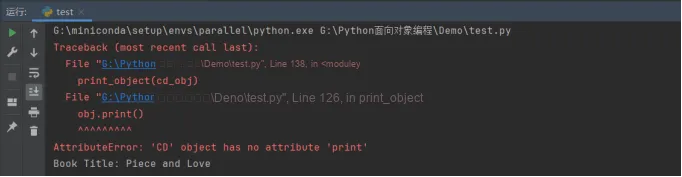
print_object(cd_obj)

The running results are as follows:

The most beginner-friendly Object Oriented programming tutorial across the network: 52 Python function methods and interfaces - Protocol and interfaces

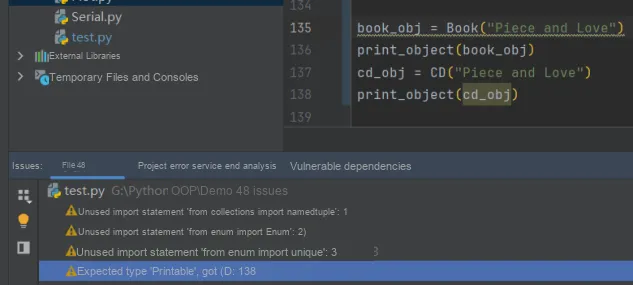
There will actually be relevant prompts in the IDE as well:

138

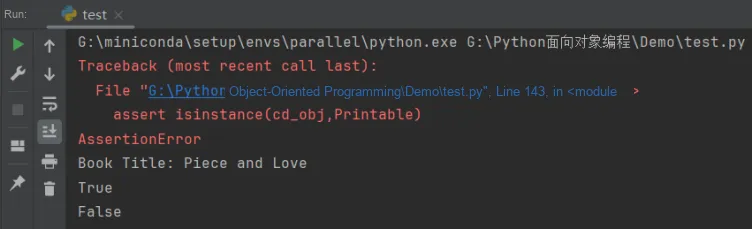
Actually, the essence of a Protocol can be understood as: "as long as this class implements the xxxx method, it will implicitly become a subclass of mine". This construct is primarily intended for static type checkers, and is of the same nature as PEP 484 and PEP 526. We can also use the @typing.runtime_checkable decorator to mark a Protocol class as a runtime protocol, which can be used together with isinstance () and issubclass (). When applied to a non-protocol class, this will raise a TypeError.

# Import the Protocol
from typing import Protocol
import typing
# Define the Printable protocol, which requires a print method
@typing.runtime_checkable
class Printable(Protocol):
    def print(self) -> None:
        pass
... ...
# Create an object instance
book_obj = Book("Piece and Love")
print_object(book_obj)
cd_obj = CD("Piece and Love")
# Type check
print(isinstance(Book,Printable))
assert isinstance(book_obj,Printable)
print(isinstance(CD,Printable))
assert isinstance(cd_obj,Printable)

The running results are as follows:

143

We can also define protocols that combine multiple other protocols. Below, we define a protocol named Serialized using the serialization approach, and then we define another protocol named PrintableAndSerializing, which combines the Printable and Serializing protocols.

class Serializable(Protocol):
    def serialize(self) -> str:
        pass

class PrintableAndSerializable(Printable, Serializable):
    pass

Compared with approaches such as abstract base classes, protocols provide a way to define structural types in Python, allowing us to create interfaces without explicit inheritance. They enable type checkers to dynamically verify whether an object conforms to the defined protocol, thereby enhancing the correctness and maintainability of code.

347622978