Contents
- I. Module Introduction
- 2. Introduction to Main Chips
- 2.1 Chip Overview
- 2.2 Pin Definition
- 2.3 Functional Block Diagram
- 2.4 Performance Parameters
- 2.5 Reference Circuit
- 2.6 Chip Configuration
- 2.7 Communication Interfaces and Related Protocols
- 2.8 PCB Routing Precautions
- III. Circuit Engineering
- 3.1 Circuit Source Engineering
- 3.2 Module Usage Instructions
- 3.3 Application Experiment
- 4. Drivers
- 5. BOM & Recommended Alternative Parts
- VI. Revision History
- VII. Relevant Materials
- 7.1 Chip Datasheet
- 7.2 Unique Icons for PCB Silk Screen
I. Module Introduction
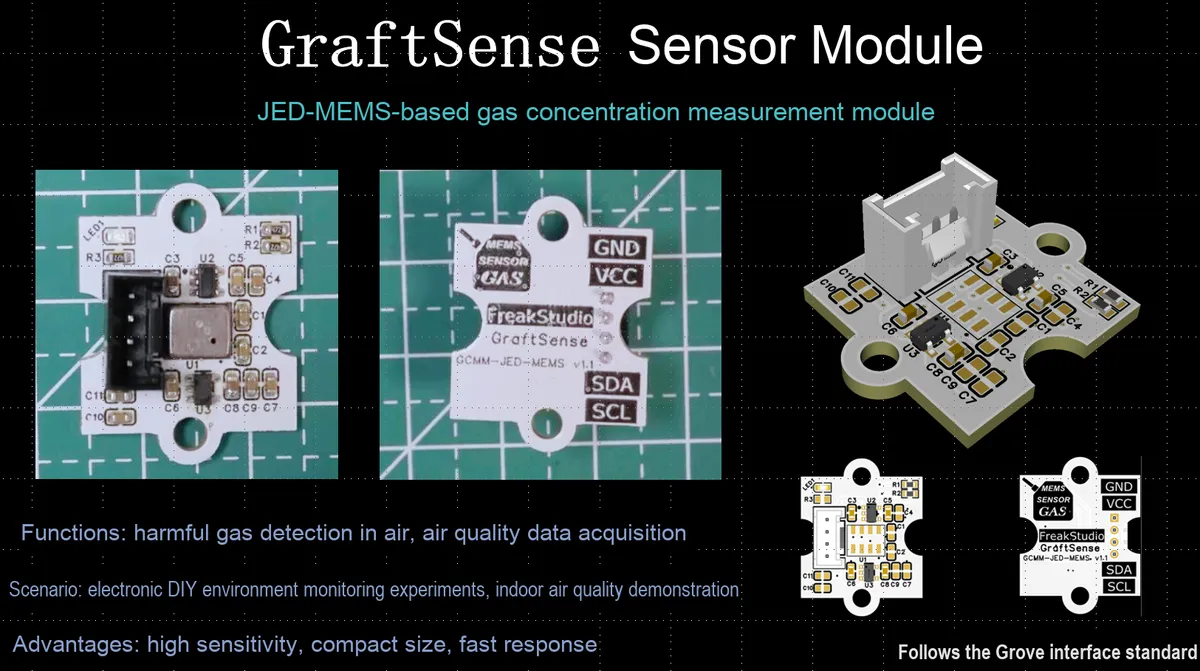
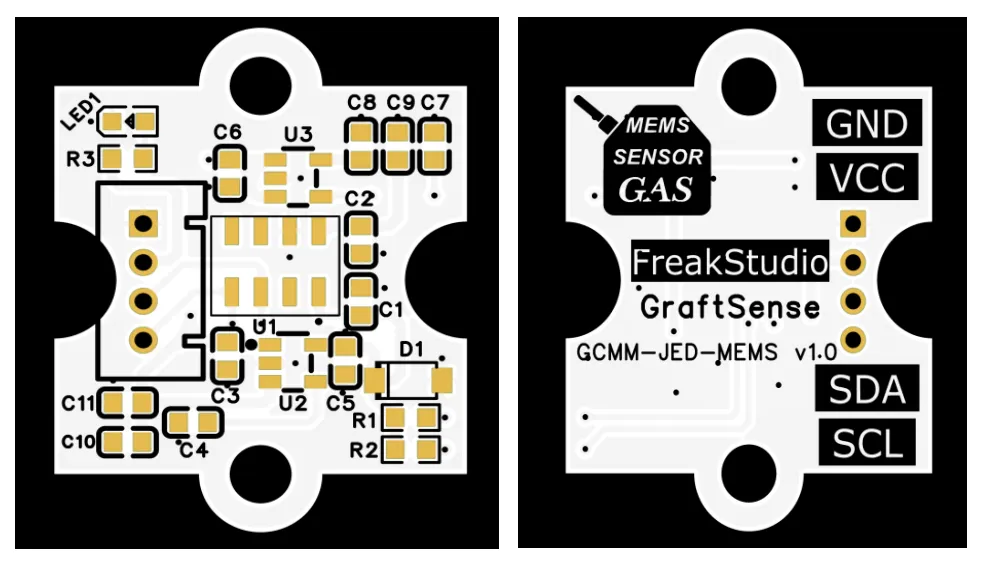
The JED-MEMS-based gas concentration measurement module is a multi-gas detection module that supports I2C communication. It is compatible with replaceable sensor probes including smoke (JED115), carbon monoxide (JED104), VOC (JED101), formaldehyde (JED116) and other types of MEMS sensor probes, and outputs digital detection data.The module is powered by 5V, and stepped down to 3.3V (for the module circuit) and 1.4V (for sensor heating) respectively through dual DC-DC circuits. Equipped with auxiliary circuits such as power filtering and power indicator, the sensor has a working current ≤25mA, a response time within 60s (30s preheating required after power-on), adapts to mainstream systems, and features flexible probe replacement as well as stable and practical performance.
| Sensor name | Model number | Measurement range | Response time | I2C speed | Default address |
|---|---|---|---|---|---|
| Formaldehyde sensor | JED116 | 0–100ppm | ≤60S | 10–100kbps | 0x54 |
| Smoke sensor | JED115 | 300–10000ppm | ≤60S | 10–100kbps | 0x54 |
| VOC sensor | JED101 | 0–100ppm | ≤60S | 10–100kbps | 0x54 |
| Carbon monoxide sensor | JED104 | 0–500ppm | ≤60S | 10–100kbps | 0x54 |
2. Introduction to Main Chips
2.1 Chip Overview
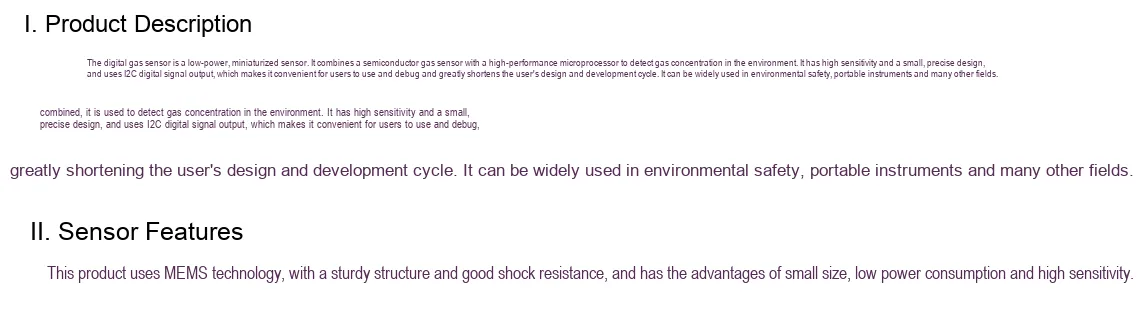
The gas concentration measurement module based on JED-MEMS is a low-power, miniaturized gas detection module manufactured with MEMS process, supporting I2C digital signal output, featuring easy operation and debugging as well as shortened design and development cycle;This module only needs to replace the sensor probe to adapt to gas detection requirements in different fields — it supports interchangeable formaldehyde sensors (JED116), smoke sensors (JED115), VOC sensors (JED101), and carbon monoxide sensors (JED104), which are respectively used for the concentration detection of formaldehyde, smoke, VOC, and CO in scenarios such as portable instruments and medical and health care, and are widely applicable to scenarios including environmental safety and portable devices.
2.2 Pin Definition
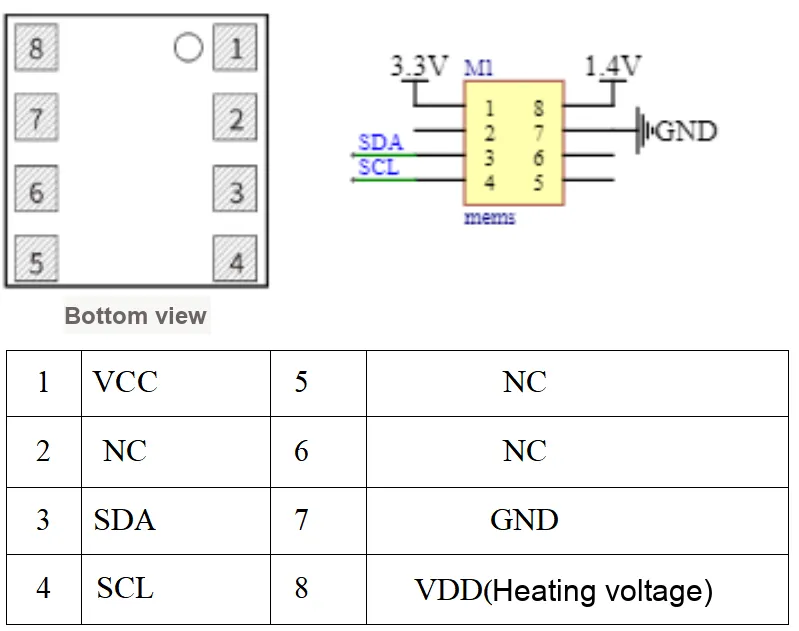
This JED-MEMS sensor adopts an 8-pin package. The pin functions of the following 4 gas sensors, namely formaldehyde sensor (JED116), smoke sensor (JED115), VOC sensor (JED101), and carbon monoxide sensor (JED104), are all consistent. The functions of each pin are as follows: Pin 1 is VCC (power supply pin), Pin 3 is SDA (I2C data communication pin), Pin 4 is SCL (I2C clock communication pin), Pin 7 is GND (ground pin), and Pin 8 is VDD (sensor heating voltage pin);Pins 2,5 and 6 are NC (No Connection, with no actual function).
2.3 Functional Block Diagram
None.
2.4 Performance Parameters
2.4.1 Formaldehyde Sensor (JED116) Performance Parameters
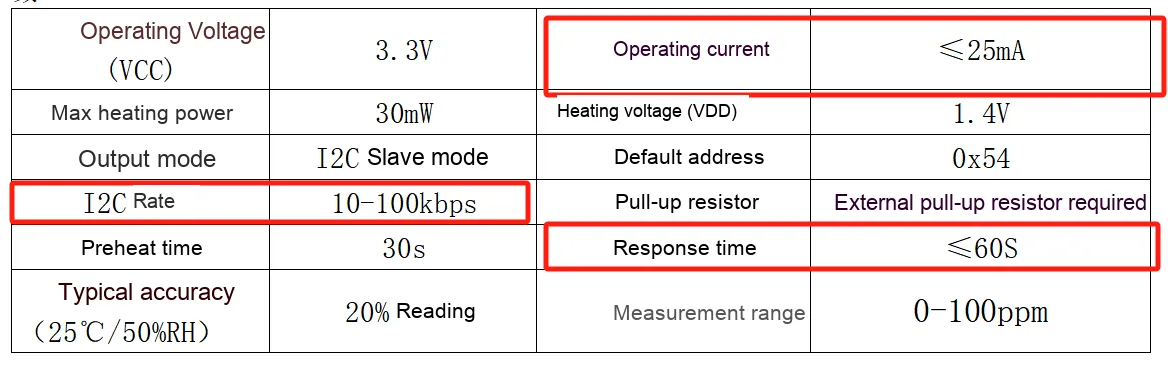
2.4.2 Smoke Sensor (JED115) Performance Parameters
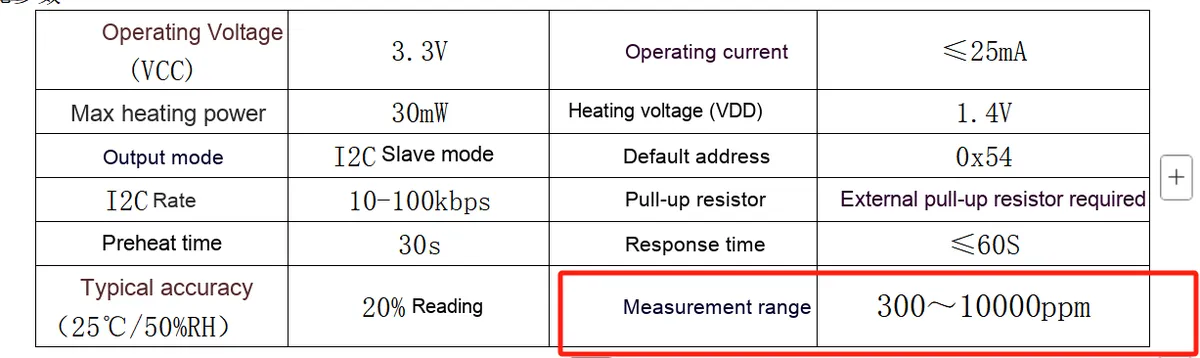
2.4.3 Performance Parameters of VOC Sensor (JED101)
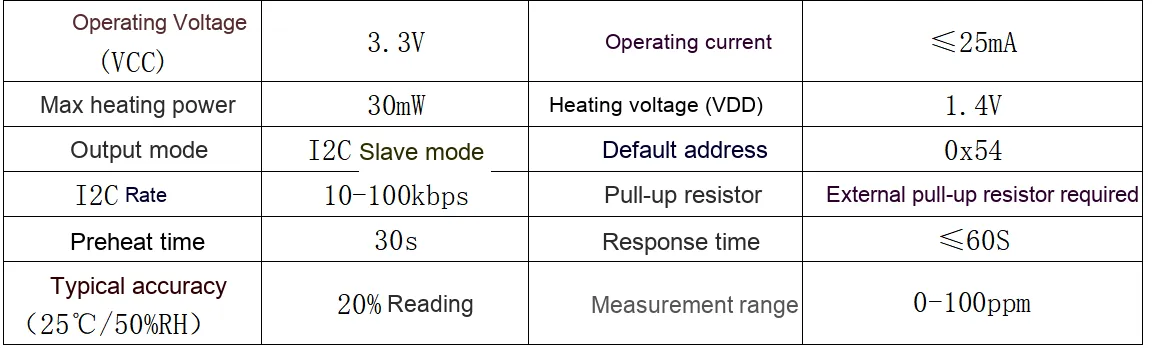
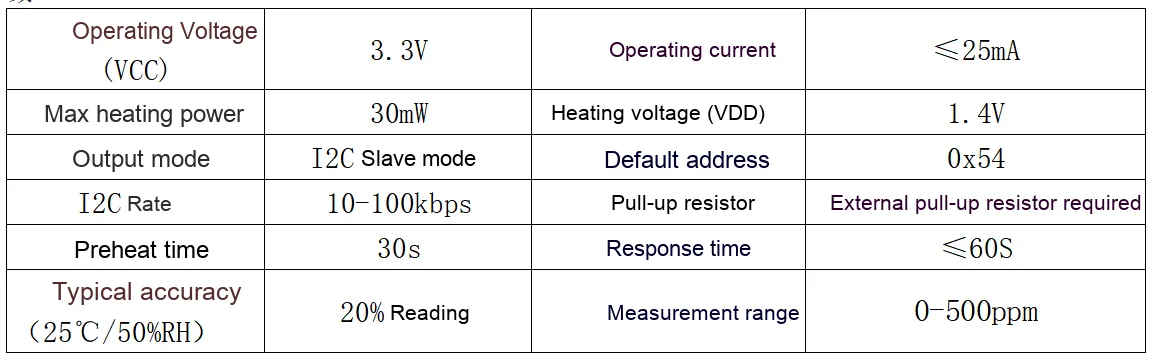
2.4.4 Carbon Monoxide Sensor (JED104) Performance Parameters
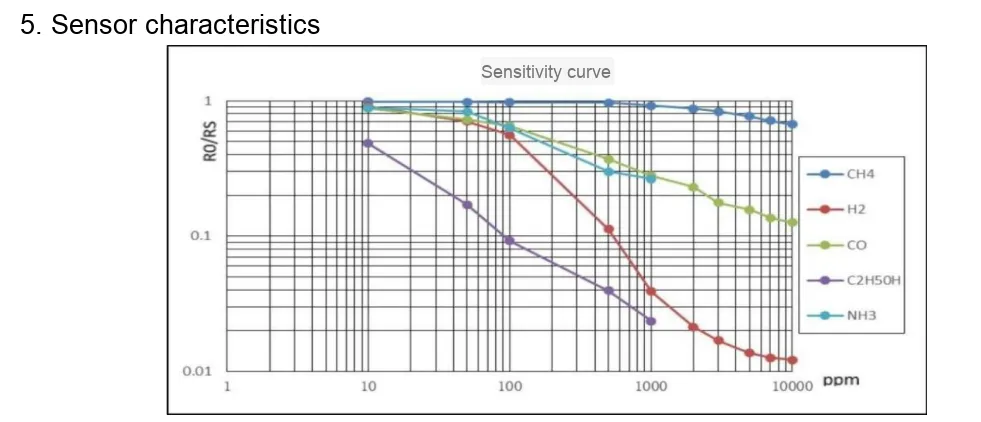
The sensitivity curve of this MEMS takes gas concentration (ppm) as the horizontal axis and R0 / RS (the resistance ratio of the sensor in clean air to that in the target gas) as the vertical axis, demonstrating the sensitivity differences to various gases: the curve corresponding to CH4 basically stays around 1, indicating extremely low sensitivity to it; while the H2, CO, C2H5OH, and NH3 exhibit a decreasing trend of R0 / RS as the concentration rises (i. e., higher concentration corresponds to higher sensitivity); among them, C2H5OH is more sensitive to low concentrations, and H2 shows outstanding sensitivity at high concentrations, with obvious sensitivity differences between the various gases.
2.5 Reference Circuit
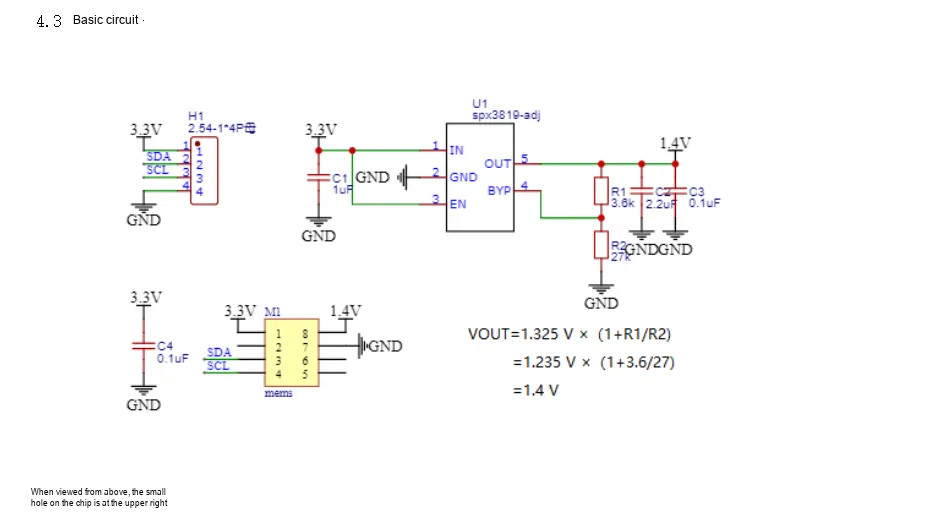
This MEMS reference circuit mainly consists of two parts: power regulation and filtering, and MEMS power supply and communication: via the spx3810adj voltage regulator chip, the 3.3V input is divided and adjusted by R1 (3.6k) and R2 (27k) to output the 1.4V heating voltage required by MEMS; the main power supply of MEMS is 3.3V, which is matched with capacitors such as 0.1uF for filtering to stabilize the power supply;MEMS ’s SDA and SCL pins are used for I2C communication. The circuit is designed with voltage regulation and filtering to ensure stable MEMS power supply and reliable communication.
2.6 Chip Configuration
None.
2.7 Communication Interfaces and Related Protocols
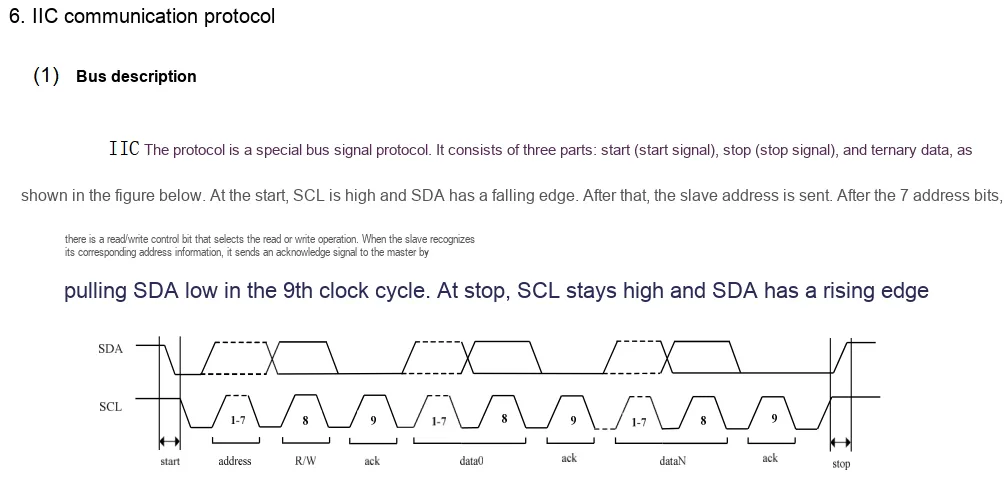
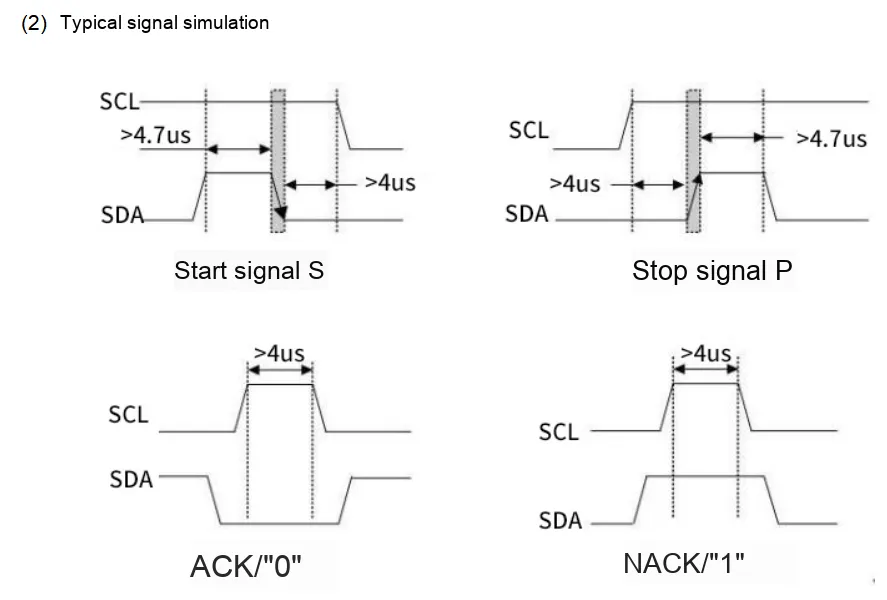
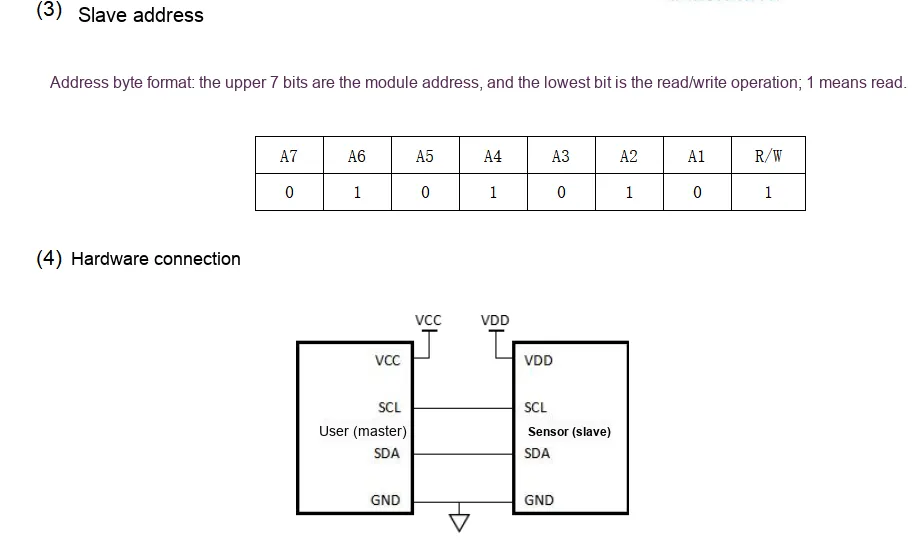
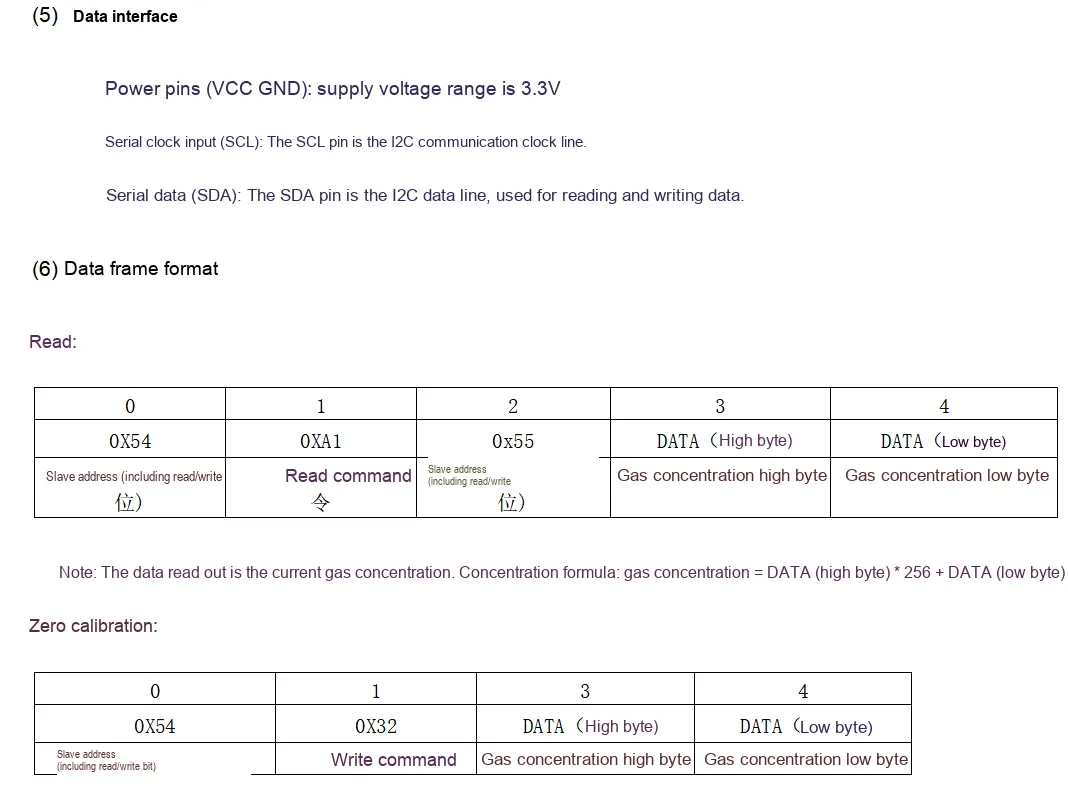

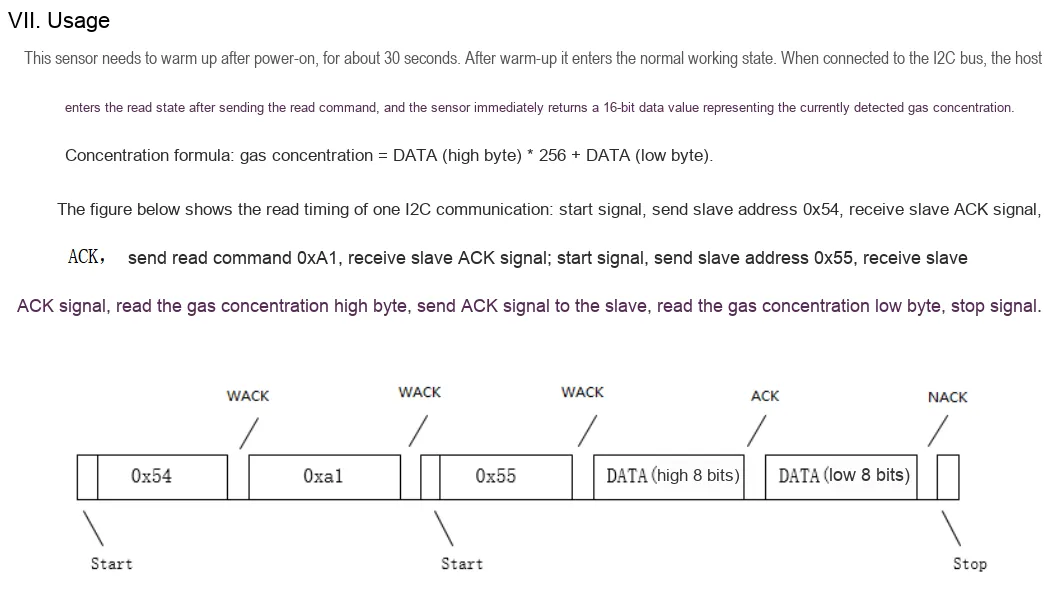
MEMS sensor adopts the IIC communication protocol, the upper 7 bits of the slave address are 0101010 (the addresses corresponding to read operations are 0x54 and 0x55), the communication includes start, stop, data and acknowledge signals (the timing has clear time requirements); the hardware needs to connect the VCC (3.3V power supply), GND, SCL, SDA of the host and the sensor correspondingly;The data frame supports reading and zero reset. During reading, the host sends the slave address 0x54, read command 0xA1, and slave address 0x55, then obtains the high and low byte data of the gas concentration, which is calculated as "high byte × 256 + low byte"; the sensor requires a 30-second warm-up after power-on, and the host can send commands to read the gas concentration after the warm-up is completed.
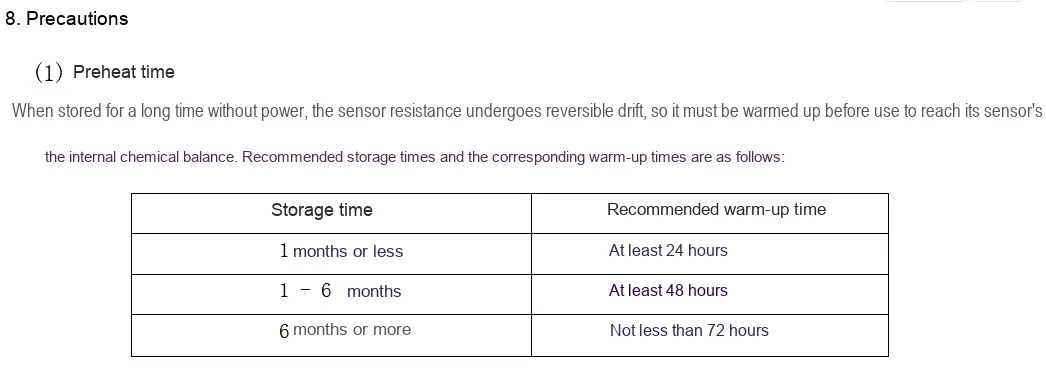
2.8 PCB Routing Precautions

III. Circuit Engineering
3.1 Circuit Source Engineering
To obtain the circuit source project, please follow the official account [Freak Embedded].
3.2 Module Usage Instructions
The schematic diagram of this module is shown below:
SCH_JED-MEMS-Based Gas Concentration Measurement Module_v1.1.pdf 2.0 MB
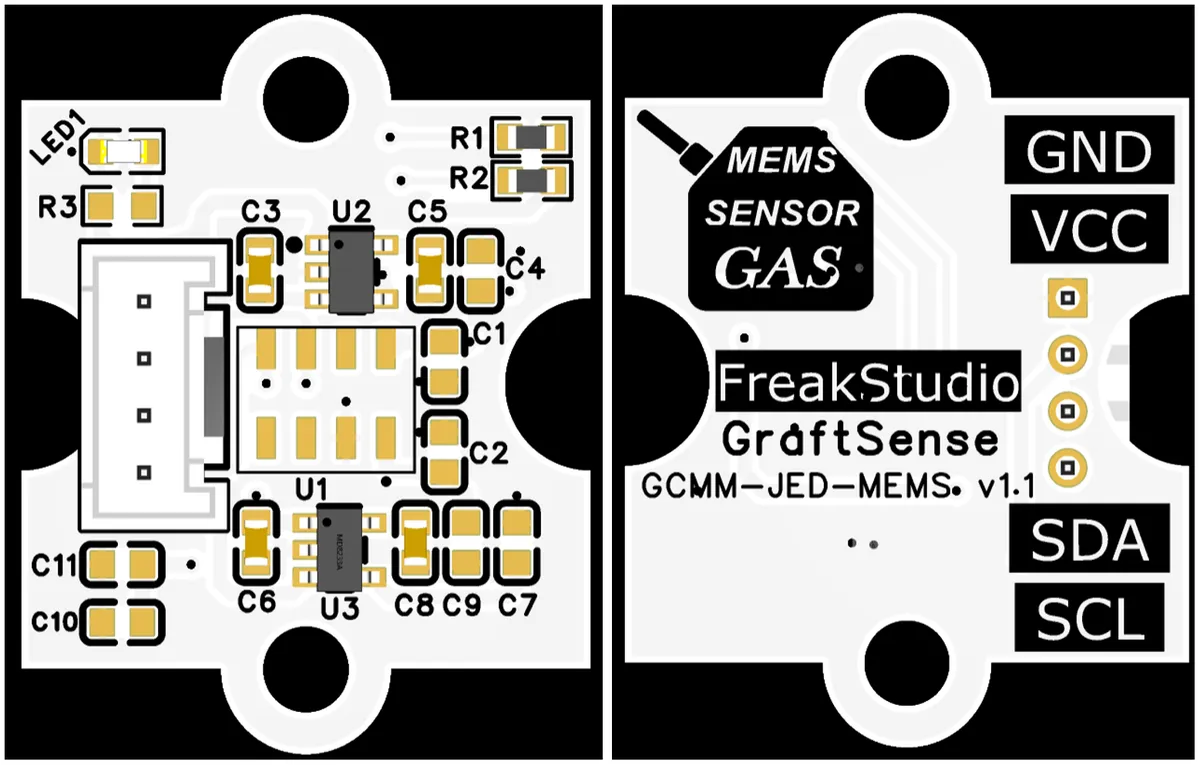
This module provides an IIC communication interface : supports standard I2C communication rate, compatible with 3.3V/5V level, can transmit digital gas concentration data of different MEMS probes such as smoke, carbon monoxide, VOC , formaldehyde, etc. through this interface, without additional signal conversion, adapted to mainstream single-chip microcomputer systems such as Arduino and STM32 , and can stably match the detection data interaction after probe replacement, providing convenient and reliable digital communication capabilities for multi-gas detection scenarios.
Two points should be noted during use:
- The sensor first needs to warm up for about 30 seconds before it can normally measure the gas concentration;
- Before measuring the concentration, it is first necessary to perform zero calibration in air.
In addition, please note that when used in the MicroPython environment, this JED-MEMS gas module may exhibit the phenomenon of "hardware I2C reporting EIO error, while software I2C can read and write normally", and the possible causes are as follows:
- Protocol Compatibility Differences: The hardware I2C controller strictly complies with the I2C specification and has extremely strict requirements for ACK response timing, bus level, repeated start conditions, etc. ; while the slave implementation of the module (especially the communication after the preheating phase and zero calibration operation) may have slight timing deviations or non-standard ACK responses, which will cause the hardware controller to determine a bus error. The software I2C directly drives the bus through GPIO, and has higher fault tolerance for these non-standard behaviors.
- Module Usage Characteristics Impact: The module requires a 30-second warm-up, and the zero-calibration operation will alter its internal state, which may lead to response delay or timing abnormality during the first communication. The built-in timeout mechanism of hardware I2C will directly trigger EIO upon a slightly slow response, while software I2C has no hardware-level timeout and relies on code delay waiting, which can adapt to the response rhythm of the module.
- Driver implementation adaptability: The I2C protocol implementation of the module (such as data frame format and address processing) is more adapted to the loose timing of software I2C, and has compatibility issues with the strict driver of hardware I2C, especially when dealing with repeated start conditions or clock stretching.
3.3 Application Experiment
Here, we use the GraftPort-RP2040 development board for testing, and the JED-MEMS-based gas concentration measurement module uses the I2C interface to communicate with the main controller.
Here, we first use the HY2.0-4P cable to connect the module to the GraftPort-RP2040 development board's I2C0 interface:
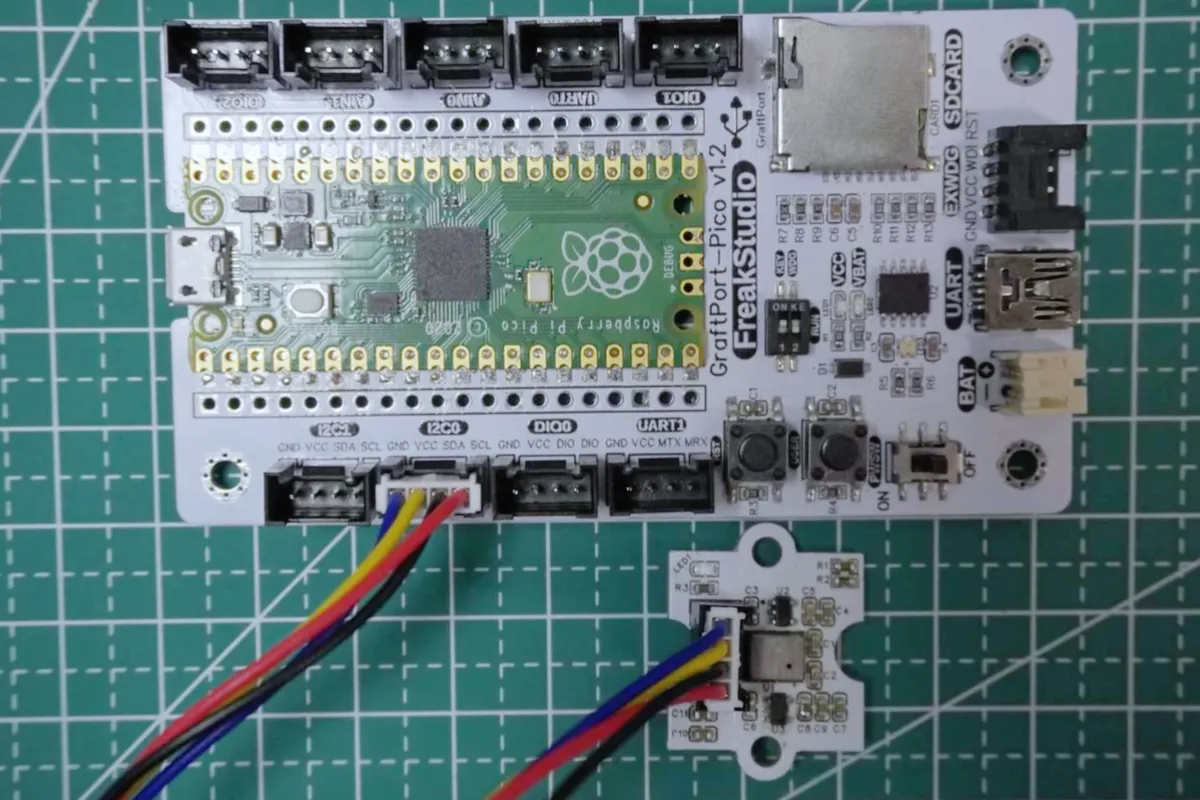
The module connections are shown in the following table:
Development Board Pins | Module Pins | Description |
Pin 4 |
|
|
Pin 5 |
|
|
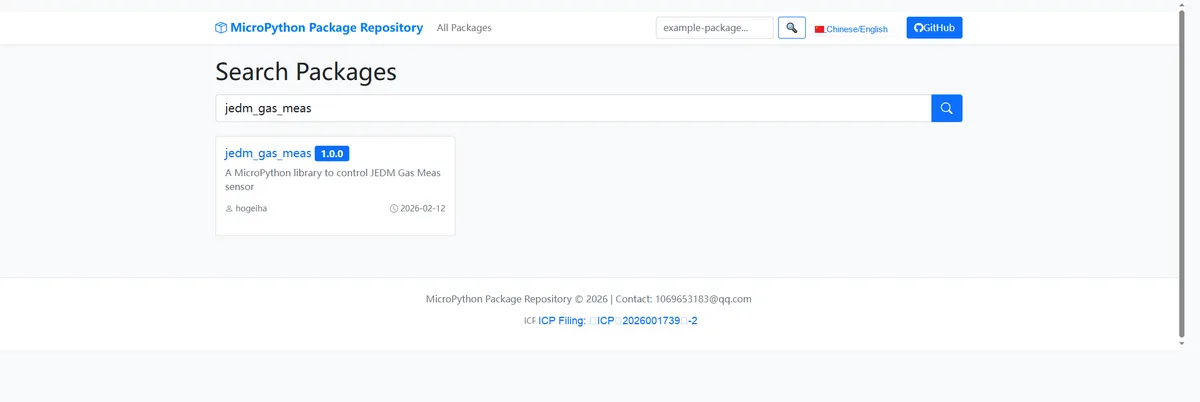
Here, we need to search for the relevant driver packages on uPyPI: https://upypi.net/zh/
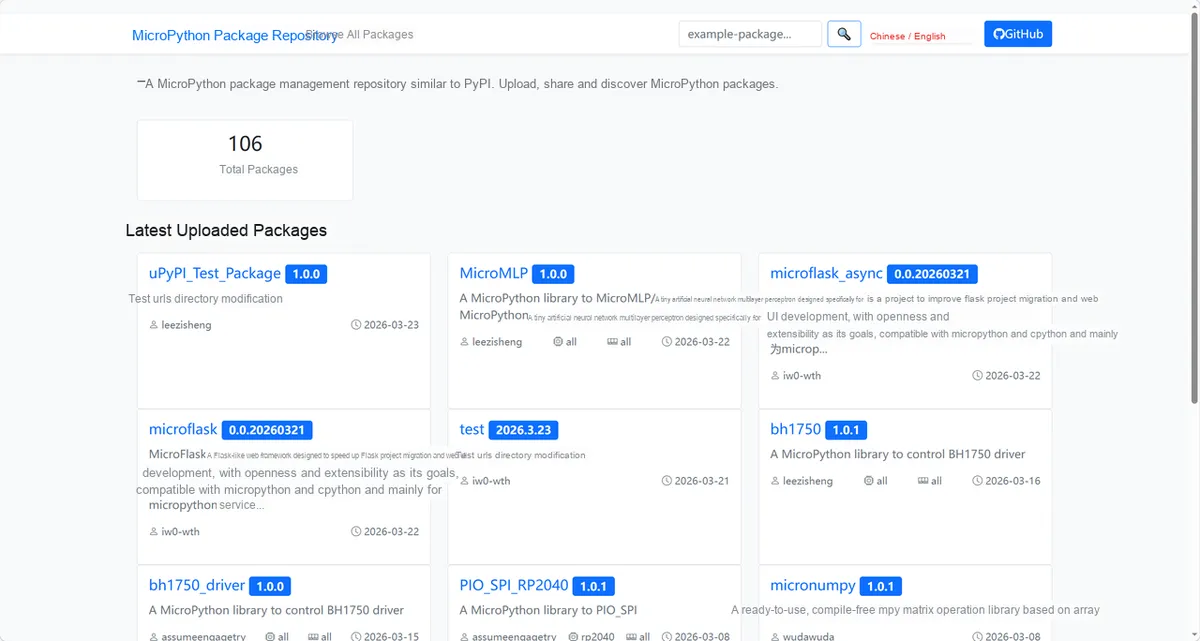
Enter jedm_gas_meas to search, and the following will be displayed:
Click to copy the local installation command:
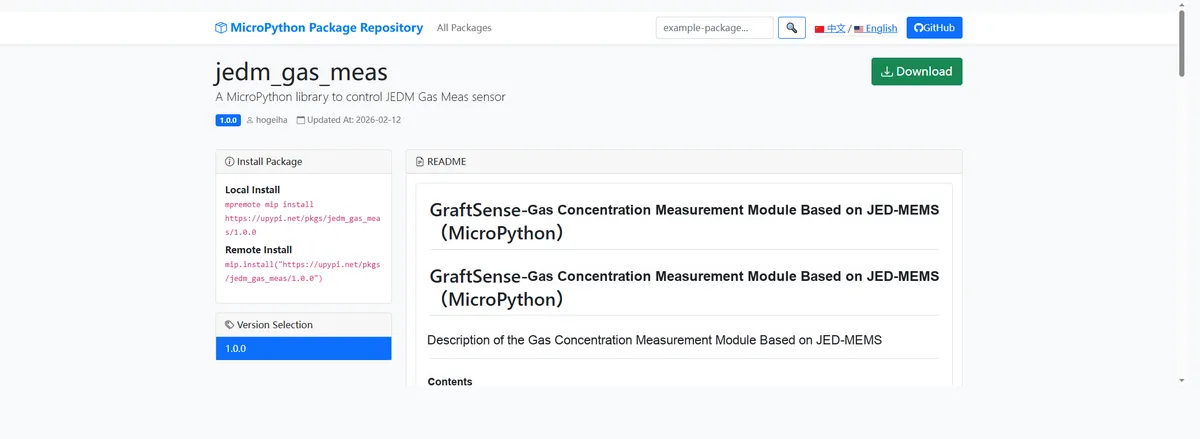
Here, we can import the module driver library code via the mip tool. The following are the usage commands for the mpremote tool:
mpremote mip install github:FreakStudioCN/GraftSense-Drivers-MicroPython/sensors/jedm_gas_measAfter importing the JED-MEMS-based gas concentration measurement module - MicroPython driver code, copy the following main.py code into our project:
# Python env   : MicroPython v1.23.0
# -*- coding: utf-8 -*-
# @Time    : 2025/12/22 PM 2:21
# @Author  : leeqingshui
# @File    : main.py
# @Description : Test code for the JED series MEMS digital sensor module

# ======================================== Import Modules =========================================

# Import time-related modules
import time
# Import hardware-related modules
from machine import SoftI2C, Pin
# Import the custom driver class
from jedm_gas_meas import JEDMGasMeas

# ======================================== Global Variables ============================================

# Sensor target 7-bit address
TARGET_SENSOR_ADDR = 0x2A
# Sensor module address
SENSOR_ADDRESS = 0

# ======================================== Functions ============================================

# ======================================== Custom Classes =============================================

# ======================================== Initialization configuration ===========================================

# Power-on delay of 3 s
time.sleep(3)
print("FreakStudio:Using JED MEMS Digital Sensor to measure gas Concentration")

# Create a software I2C instance using the I2C0 peripheral, 100KHz clock frequency, SDA pin 4, SCL pin 5
# For this module, the maximum allowed I2C communication rate (100KHz)
i2c = SoftI2C(sda=Pin(4), scl=Pin(5), freq=100000)
# If the sensor module has no pull-up resistors, internal pull-ups are needed
# i2c = SoftI2C(sda=Pin(4, pull=Pin.PULL_UP), scl=Pin(5, pull=Pin.PULL_UP), freq=100000)

# Start scanning for devices on the I2C bus and return a list of slave addresses
devices_list = i2c.scan()
print('START I2C SCANNER')

# If devices_list is empty, no device is connected to the I2C bus
if len(devices_list) == 0:
    print("No i2c device !")
# If not empty, print the slave device addresses
else:
    print('i2c devices found:', len(devices_list))
    # Iterate over the slave device address list
    for device in devices_list:
        print("I2C hexadecimal address: ", hex(device))
        if device == 0x2A:
            SENSOR_ADDRESS = device

# Check whether the target sensor address was found
if SENSOR_ADDRESS is None:
    raise ValueError("Target sensor address not found")

# Create the sensor module instance
mems_gas_sensor = JEDMGasMeas(i2c, SENSOR_ADDRESS)

# Sensor warm-up for 30 seconds
print("Sensor preheating for 30 seconds...")
time.sleep(30)
print("Preheating completed.")

# Zero calibration: place in ventilated air, perform zero calibration and check the result
print("Starting zero calibration...")
calib_success = mems_gas_sensor.calibrate_zero()
if calib_success:
    print("Zero calibration succeeded.")
else:
    print("Error: Zero calibration failed! Program exit.")

# ========================================  Main Program  ===========================================

while True:
    try:
        # Get the current gas concentration
        gas_concentration = mems_gas_sensor.read_concentration()
        print(f"Measure Gas Concentration: {gas_concentration}")
    except Exception as e:
        print(f"Error reading concentration: {e}")
    # Test once every 1s
    time.sleep(1)
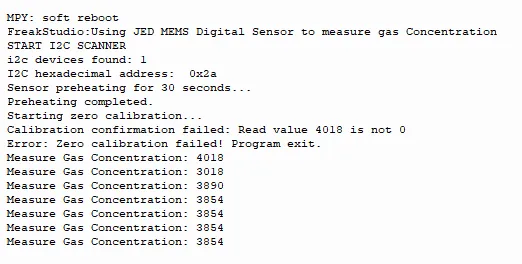
Burn the code, open the terminal, and the output is as follows:
4. Drivers
jedm_gas_meas.rar 9 KB
5. BOM & Recommended Alternative Parts
None.
VI. Revision History
Document Version | Date of Modification | Modifier | Revised Content |
v1.0 | 2025-12-25 | Zero Kōkō | Initialize Document |
v1.1 | 2025-12-29 | Li Zisheng | Added application experiments and production files |
v1.2 | 2026-02-13 | Li Zisheng | Modify the circuit engineering and re-edit the document. |
v1.3 | 2026-03-29 | Xin Ruili | Modified the application experiment section |
VII. Relevant Materials
7.1 Chip Datasheet
MEMS Digital Design Guide.doc 671 KB
MEMS Digital CO Sensor JED104-001.docx 452 KB
MEMS Digital VOC Sensor JED101-001.docx 452 KB
MEMS Digital Smoke Sensor JED115-001.docx 452 KB
MEMS Digital Formaldehyde Sensor JED116-001.docx 452 KB
7.2 Unique Icons for PCB Silk Screen