Contents
- I. Module Introduction
- II. Introduction to Major Chips
- 2.1 Chip Overview
- 2.2 Pin Definition
- 2.3 Functional Block Diagram
- 2.4 Performance Parameters
- 2.5 Reference Circuit
- 2.6 Chip Configuration
- 2.7 Communication Interfaces and Related Protocols
- 2.8 PCB Routing Precautions
- III. Circuit Engineering
- 3.1 Circuit Source Engineering
- 3.2 Module Usage Instructions
- 3.3 Application Experiment
- 4. Drivers
- 5. BOM & Recommended Alternative Parts
- VI. Revision History
- VII. Relevant Materials
- 7.1 Chip Datasheet
- 7.2 PCB Silkscreen Specific Icons
I. Module Introduction
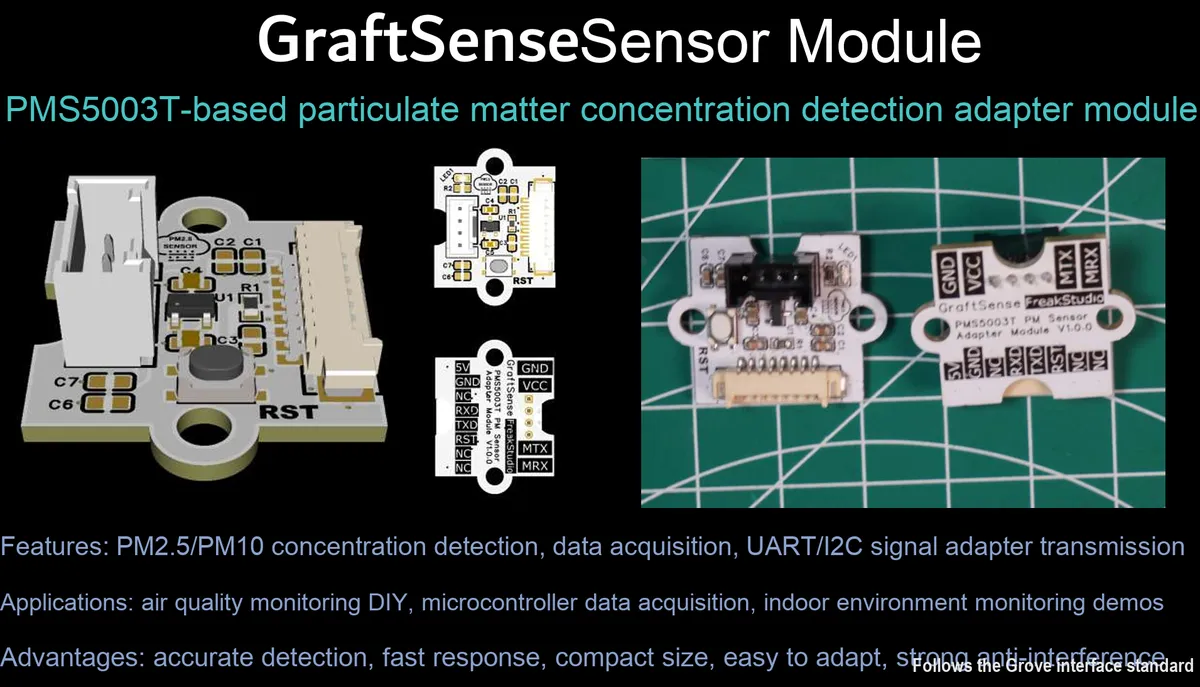
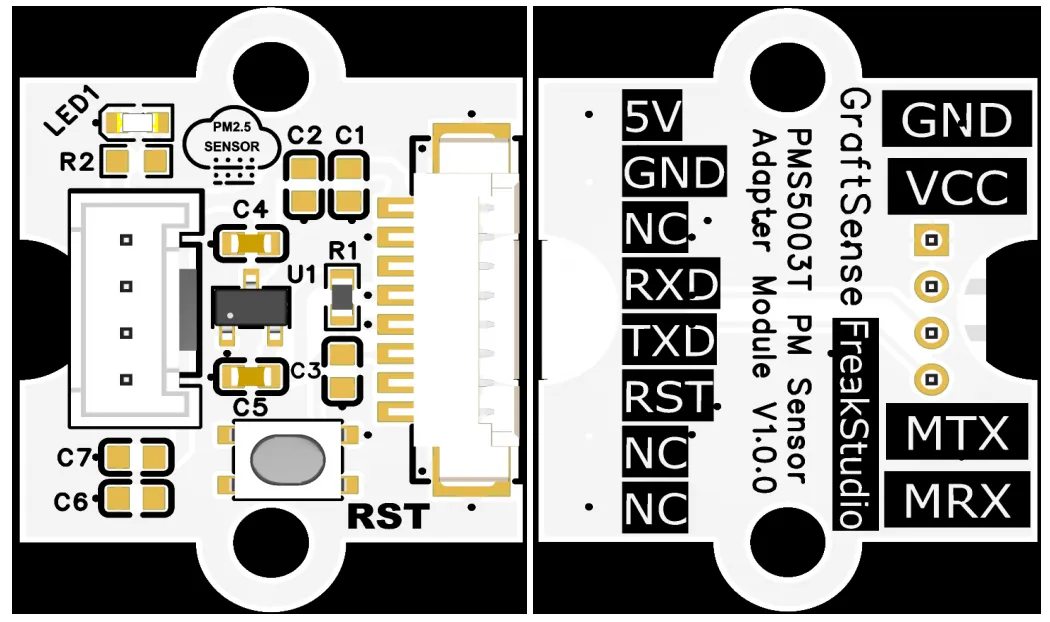
The particulate matter concentration detection adapter module based on PMS5003T is a level conversion and power supply adaptation board designed for the PMS5003T particulate matter sensor. It adopts the laser scattering principle to realize three-channel particulate matter concentration detection of PM1.0, PM2.5 and PM10, with a minimum identifiable particle size of 0.3μm, a measurement range of 0~500μg/m³, and an error of ≤±10μg/m³ in the low concentration section;This module has a built-in 5V-to-3.3V power supply circuit and reset circuit, which converts the 5V power supply and UART level of the sensor to 3.3V logic, and can directly communicate with 3.3V MCU. It supports two operating modes: active reporting and passive query, with an average power consumption of approximately 100mW, and is suitable for embedded scenarios such as air quality monitoring and environment detection.
II. Introduction to Major Chips
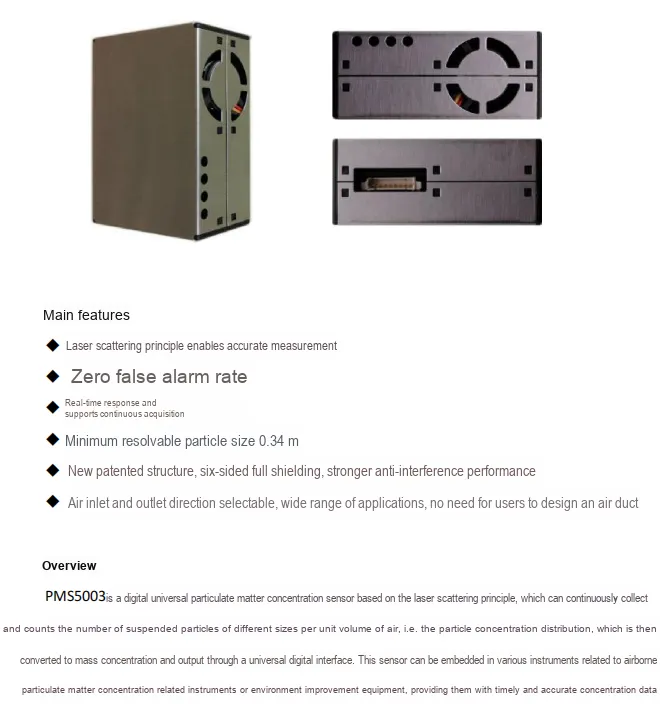
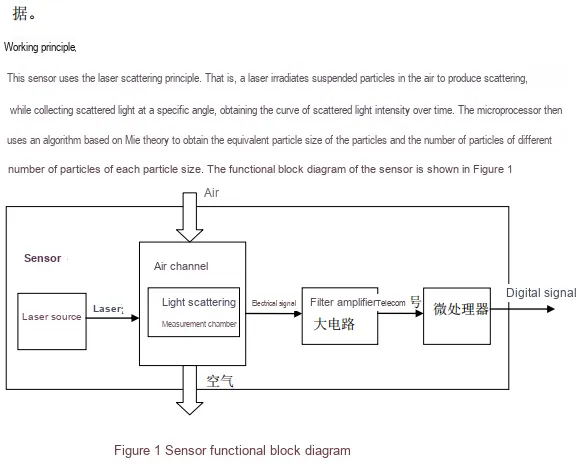
PMS5003T is a digital particulate matter sensor based on the laser scattering principle, which can simultaneously detect the concentrations of PM1.0, PM2.5 and PM10. It features a minimum identifiable particle size of 0.3μm, a measurement range of 0~500μg/m³, communicates via UART, supports both active reporting and passive query modes, and is suitable for air quality monitoring scenarios.
2.1 Chip Overview
2.2 Pin Definition
2.3 Functional Block Diagram
None.
2.4 Performance Parameters
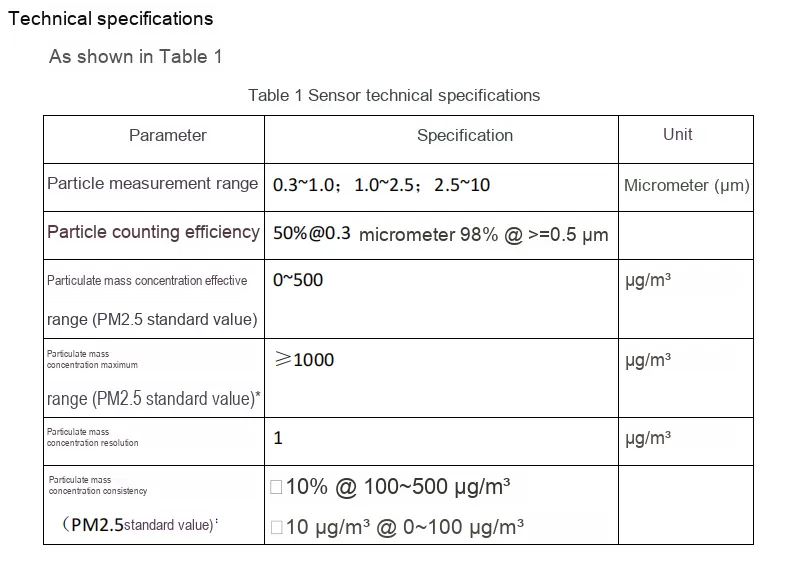
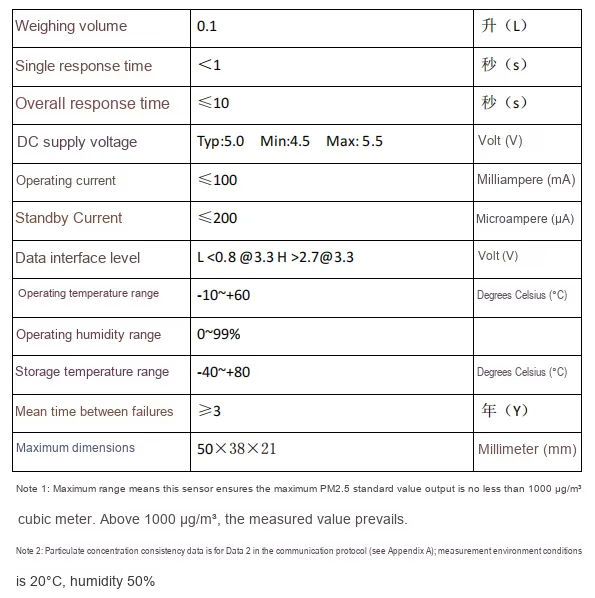
PMS5003T can detect particulate matters with a size of 0.3~10μm, PM2.5 has a measurement range of 0~500μg/m³(maximum ≥1000μg/m³), a resolution of 1μg/m³, and is powered by 5V, UART communication, a fast response time ≤10s, and a mean time between failures ≥3 years, making it suitable for high-precision air quality monitoring.
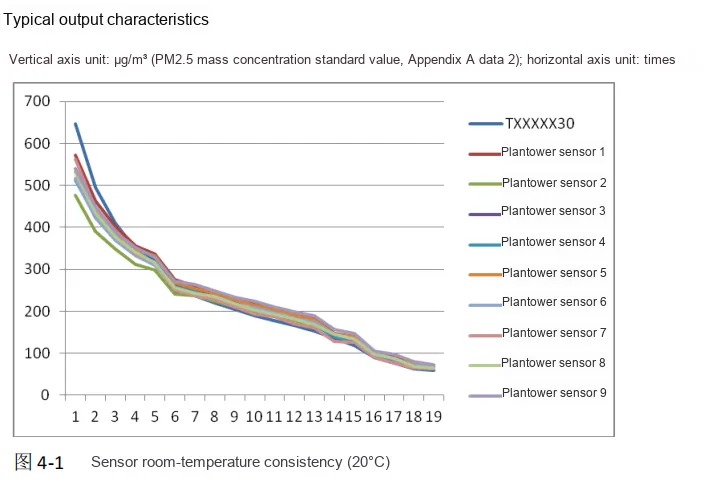
The PMS5003T series sensors feature excellent output consistency for 20℃ room-temperature PM2.5 concentration measurements: as the number of measurements increases for multiple sensors, the concentration gradually drops from approximately 600μg/m³ to around 70μg/m³, with all curves showing highly consistent trends, which demonstrates sound measurement consistency.
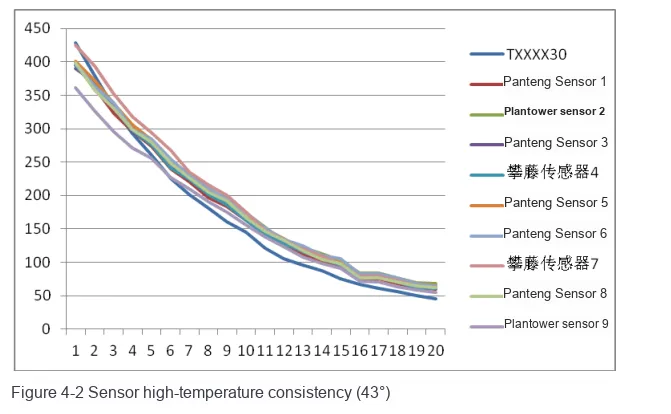
PMS5003T series sensors in and 43 ℃ high temperature environment PM2.5 concentration output consistency, multiple sensors with the increase of measurement times, the concentration from about 400μg/m ³ gradually decreased to about 60μg/m ³, each curve trend highly coincide, reflecting good high temperature measurement consistency.
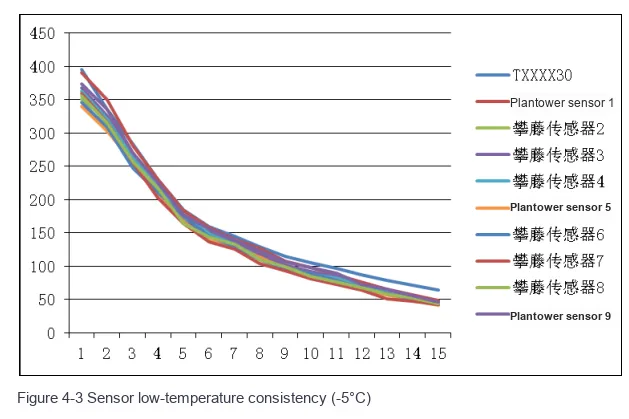
PMS5003T series sensors in - 5 ℃ low temperature environment PM2.5 concentration output consistency, multiple sensors with the increase of measurement times, the concentration from about 400μg/m ³ gradually decreased to about 50μg/m ³, the curve trend highly coincide, reflecting good low temperature measurement consistency.
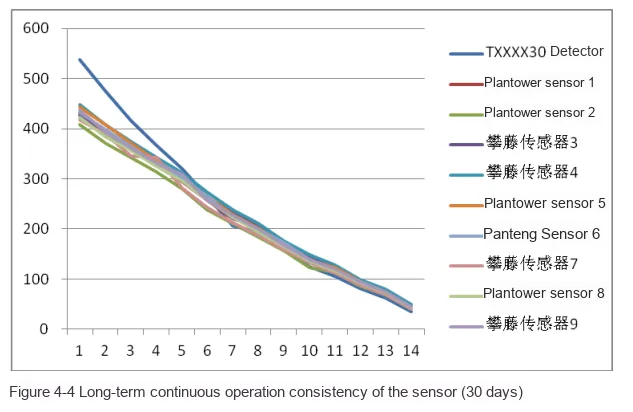
PMS5003T series sensors' 30-day long-term continuous operation PM2.5 concentration output consistency: for multiple sensors, as the number of measurements increases, the concentration gradually drops from approximately 500μg/m³ to around 50μg/m³, with all curves showing highly consistent trends, which demonstrates excellent long-term operational stability and measurement consistency.
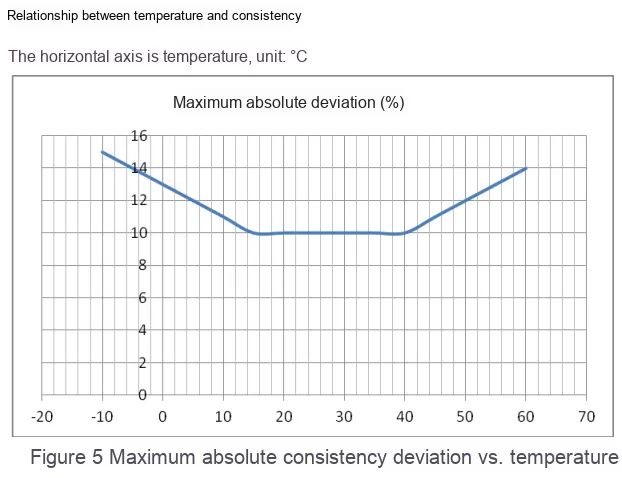
PMS5003T The absolute value of the maximum consistency deviation of the sensor shows a " U -shaped" curve with temperature changes. The deviation is the smallest (about 10%) in the range of 20-40 ℃, and the deviation increases slightly (about 14-15%) at low temperature (-10 ℃) and high temperature (60 ℃), maintaining good temperature stability as a whole.
2.5 Reference Circuit
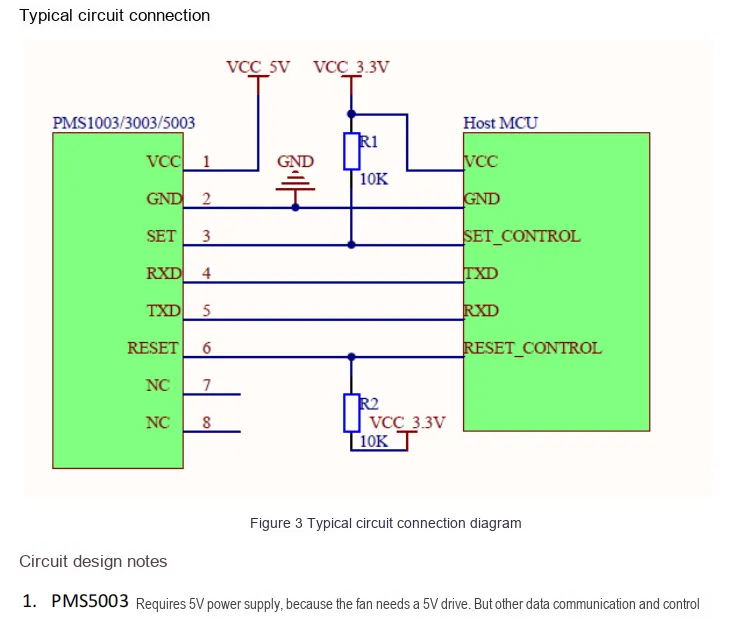
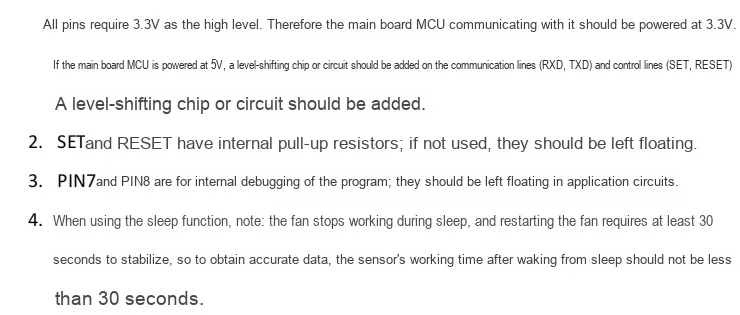
2.6 Chip Configuration
None.
2.7 Communication Interfaces and Related Protocols
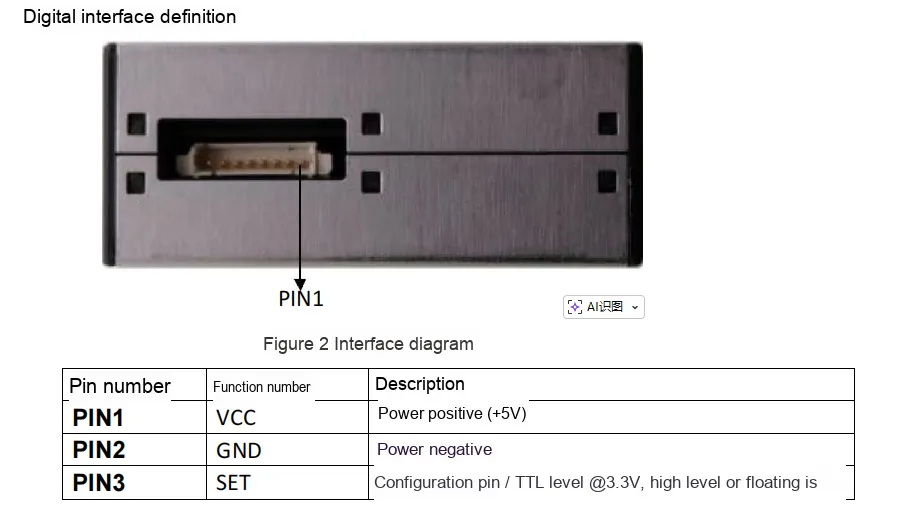
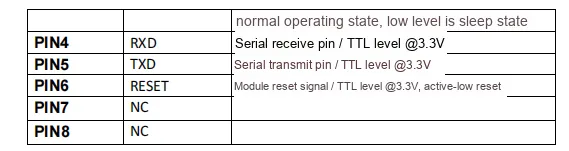
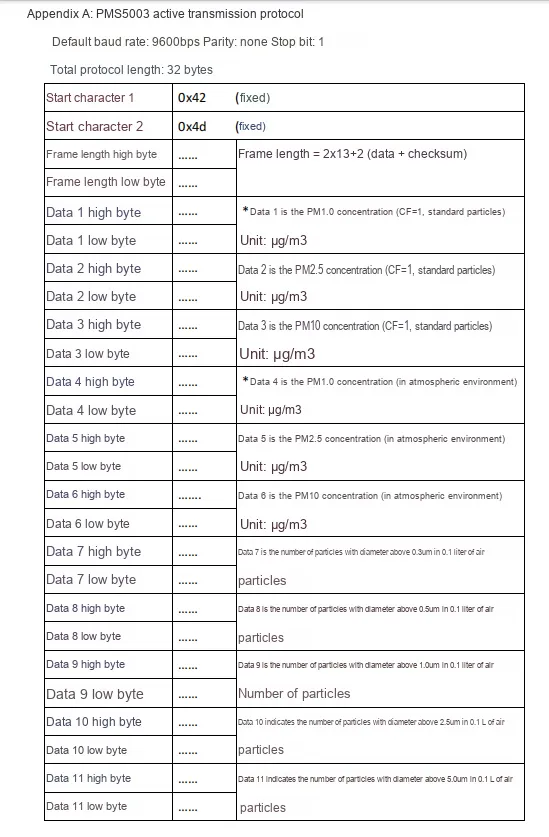
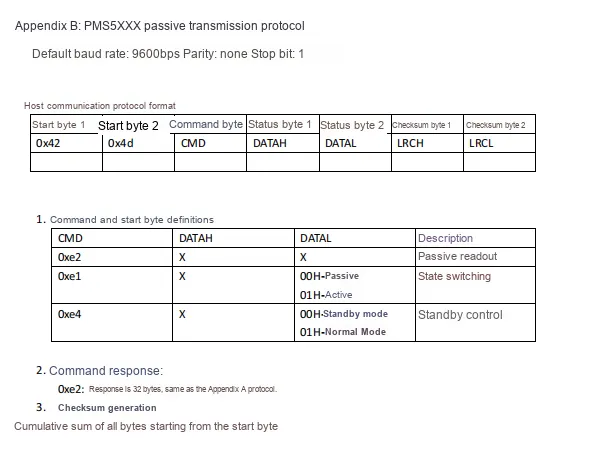
PMS5003T adopts UART communication, with the default baud rate of 9600bps, no parity, and 1 stop bit, and supports two transmission protocols, namely active mode and passive mode:
- Active Protocol: starts with the fixed start characters
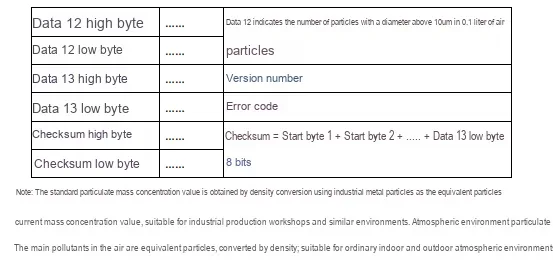
0x42 0x4d, features a fixed frame length of 32 bytes, and contains the standard and atmospheric environmental concentrations ofPM1.0/PM2.5/PM10, the number of particles with different particle sizes, the version number and the check code; the sensor actively reports data, and the check method is the sum of all accumulated bytes. - Passive Protocol: The host sends requests in the format of
0x42 0x4d + command(e. g., reading data via0xe2, switching mode via0xe1, controlling standby via0xe4), and the sensor responds with 32-byte data in active format, which is also verified by sum check. The two modes can be flexibly switched to meet the Data Acquisition requirements in different scenarios.
2.8 PCB Routing Precautions
None.
III. Circuit Engineering
3.1 Circuit Source Engineering
To obtain the circuit source project, please follow the official account [Freak Embedded].
3.2 Module Usage Instructions
The schematic diagram of this module is shown below:
SCH_Particulate Matter Detection Adapter Module Based on PMS5003T-V1.0.0_2026-03-25.pdf 2.3 MB
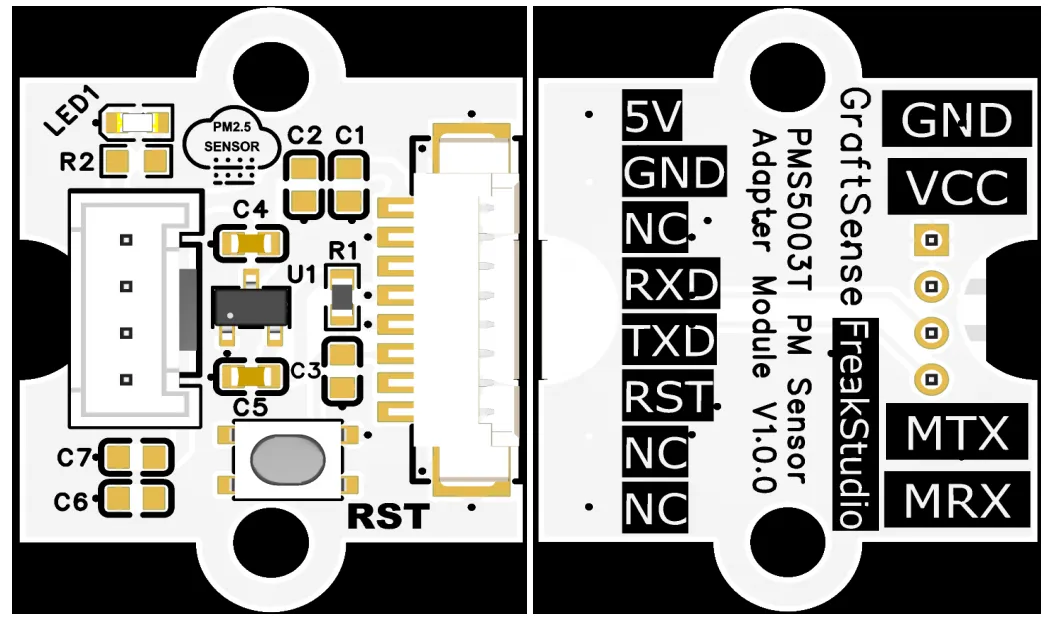
This module provides a serial port UART interface MRX and MTX: here M stands for master, meaning the MCU 's RX corresponds to the module' s TX; when in use, please ensure that the communication parameters of the microcontroller's UART interface are consistent with those of the module, so as to stably implement the read and write operations for the PMS5003T sensor's PM1.0, PM2.5, PM10 concentration data and configuration parameters through this interface. It is suitable for embedded scenarios such as air quality monitoring and environmental detection, and provides reliable particulate matter concentration data interaction capability for the system.
The module is equipped with an on-board RST reset button, which can be pressed to reset the module when necessary.
3.3 Application Experiment
Here, we use the GraftPort-RP2040 development board for testing, and the particle concentration detection adapter module based on the PMS5003T uses the UART interface to communicate with the main controller.
Here, we first use the HY2.0-4P connection cable to connect the module to the GraftPort-RP2040 development board's UART0 interface, and connect the cable interface of the particulate matter concentration detection module to the adapter module:
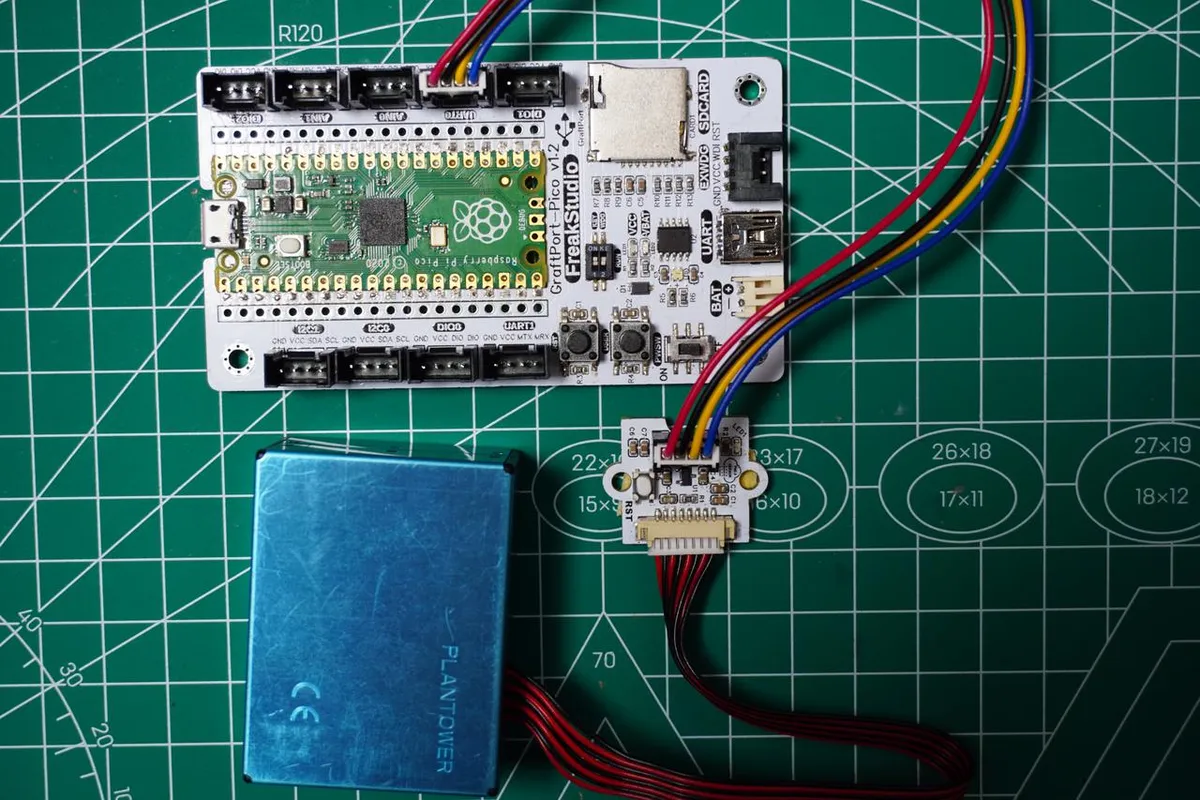
The module connections are shown in the following table:
Development Board Pins | Module Pins | Description |
Pin 16 |
|
|
Pin 17 |
|
|
Here, we need to search for the relevant driver packages on uPyPI: https://upypi.net/zh/
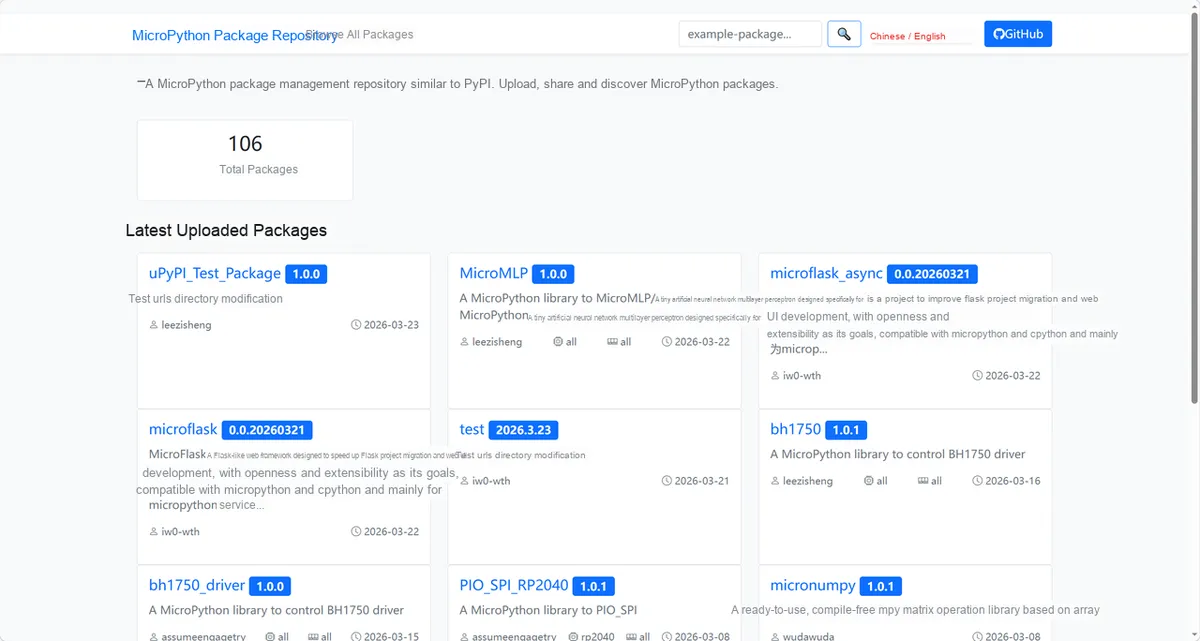
Enter pms5003t_driver to search, and the following will be displayed:

Click to copy the local installation command:
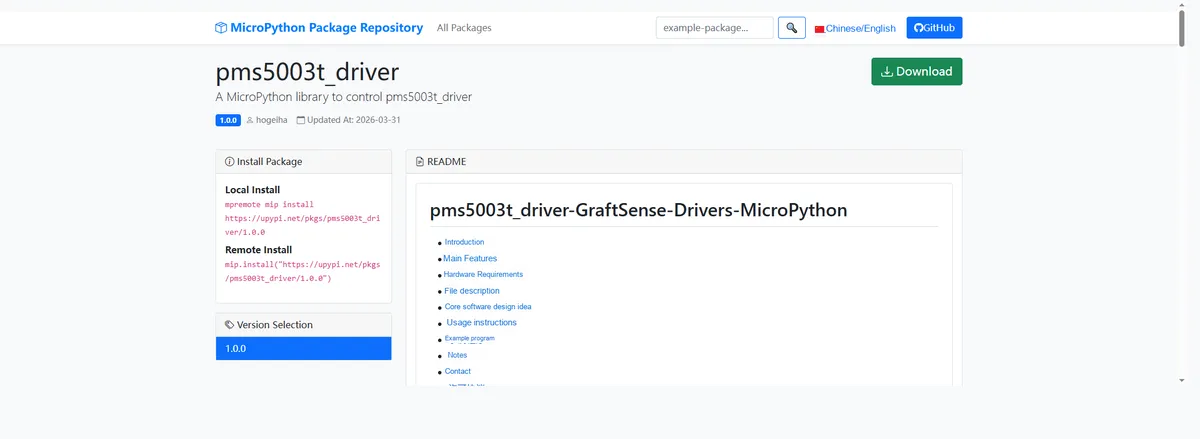
Import the module driver library code via the mip tool. Below are the usage commands for the mpremote tool:
mpremote mip install https://upypi.net/pkgs/pms5003t_driver/1.0.0Import the MicroPython driver code for the PMS5003T-based particulate matter concentration detection adapter module, then copy the following main.py code into our project:
# Python env   : MicroPython v1.23.0
# -*- coding: utf-8 -*-
# @Time    : 2026/3/27 PM 5:00
# @Author  : Kevin Köck
# @File    : main.py
# @Description : PMS5003 air quality sensor test program, demonstrating active/passive mode switching and power-saving mode

# ======================================== Import Modules =========================================

import machine

# import pms5003
import uasyncio as asyncio
import pms5003

# ======================================== Global Variables ============================================

# Get the event loop object
loop = asyncio.get_event_loop()

# Default delay parameter (unused)
_DEFAULT_MS = 20

# PMS5003 sensor instance
pm = None
# Async lock for multi-task synchronization
lock = asyncio.Lock()

# ======================================== Functions ============================================


async def printit():
    """
    Print the sensor's current measurement data
    Args: None

    Raises: None

    Notes: This function is registered as a callback on the sensor and is called automatically when new data arrives

    ==========================================
    Print current measurement data of sensor
    Args:None

    Raises:None

    Notes:This function is registered as callback, called automatically when new data arrives
    """
    pm.print()


import time


async def idle():
    """
    Idle task, sleeps periodically
    Args: None

    Raises: None

    Notes: Not used in the main program, reserved

    ==========================================
    Idle task, periodically sleeps
    Args:None

    Raises:None

    Notes:Not used in main program, reserved
    """
    while True:
        await asyncio.sleep(2)
        time.sleep_ms(5)


async def testing():
    """
    Test sensor mode switching
    Wait 120 seconds, then enter active mode; wait another 120 seconds, then switch to passive mode (power saving disabled); finally enable power-saving mode
    Args: None

    Raises: None

    Notes: Demonstrates sensor behavior in different modes

    ==========================================
    Test sensor mode switching
    Wait 120 seconds, switch to active mode, then after 120 seconds switch to passive mode (eco off), finally enable eco mode
    Args:None

    Raises:None

    Notes:Demonstrates sensor behavior in different modes
    """
    await asyncio.sleep(120)
    while pm._sleeping_state is False:
        await asyncio.sleep_ms(100)
    print("")
    print("")
    print("----------------------------------------------------------")
    print("")
    print("Setting to active mode while sleeping")
    print("")
    print("----------------------------------------------------------")
    print("")
    print("")
    asyncio.create_task(pm.setActiveMode())
    await asyncio.sleep(120)
    print("")
    print("")
    print("----------------------------------------------------------")
    print("")
    print("Setting to passive mode whithout sleeping with 20s interval")
    print("")
    print("----------------------------------------------------------")
    print("")
    print("")
    pm.setEcoMode(False)
    asyncio.create_task(pm.setPassiveMode(20))
    await asyncio.sleep(120)
    print("")
    print("")
    print("----------------------------------------------------------")
    print("")
    print("Activating EcoMode, interval will be adapted to 60s")
    print("")
    print("----------------------------------------------------------")
    print("")
    print("")
    pm.setEcoMode(True)


def start():
    """
    Initialize the sensor and start the main loop
    Args: None

    Raises: None

    Notes: Configure UART, create the PMS5003 instance, register the callback, start the test task, and run the event loop

    ==========================================
    Initialize sensor and start main loop
    Args:None

    Raises:None

    Notes:Configure UART, create PMS5003 instance, register callback, start test task and run event loop
    """
    uart = machine.UART(0, tx=16, rx=17, baudrate=9600)
    global pm
    pm = pms5003.PMS5003(uart, lock, active_mode=False, interval_passive_mode=60)
    pms5003.set_debug(True)
    pm.registerCallback(printit)
    asyncio.create_task(testing())
    asyncio.get_event_loop().run_forever()


# ======================================== Custom Classes ============================================

# ======================================== Initialization configuration ===========================================

# Wait for the system to stabilize
time.sleep(3)
# Print initialization complete message
print("FreakStudio: PMS5003 sensor driver initialized")

# ========================================  Main Program  ============================================

start()
Burn the code, open the terminal, and the output is as follows:
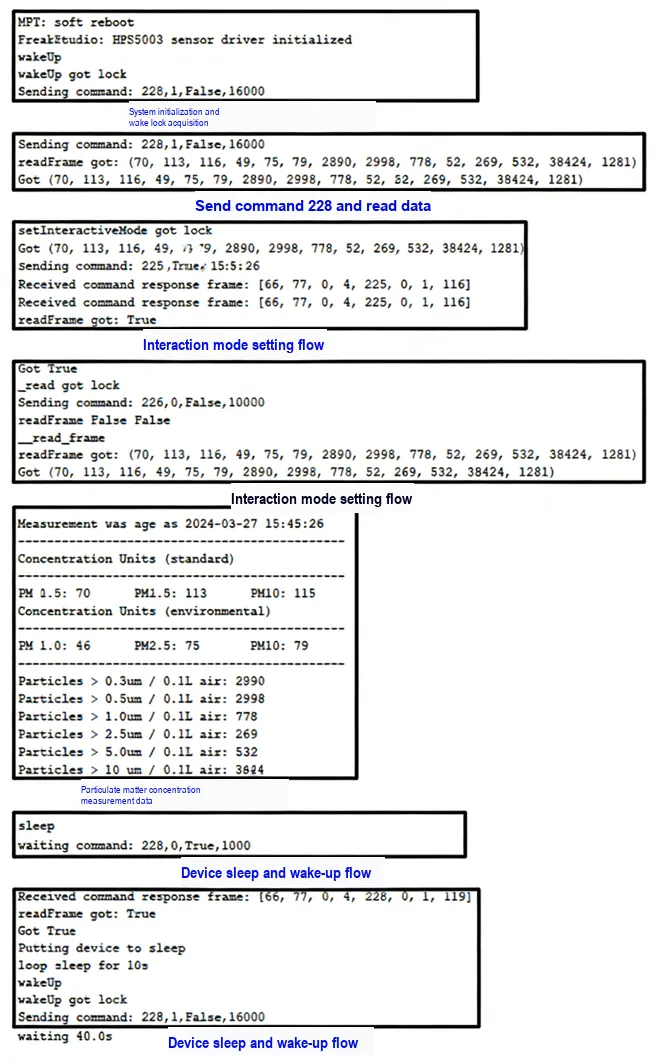
We can see the terminal print out the particulate matter concentration and AQI data.
4. Drivers
pms5003t_driver-1.0.0.zip 19 KB
5. BOM & Recommended Alternative Parts
None.
VI. Revision History
Document Version | Date of Revision | Modifier | Modify Content |
v1.0 | 2026-03-25 | Ling Gaoxing | Initialize the document |
v1.0.1 | 2026-04-05 | Li Zisheng | No photos for the homepage have been taken, the production files have not been exported yet, and all other items have been sorted out. |
v1.0.2 | 2026-04-14 | Li Zisheng | Modified main.py. |
v1.0.3 | 2026-04-21 | Li Zisheng | The production documents have not been exported yet, while all the rest have been sorted out. |
v1.1 | 2026-04-23 | Xin Ruili | Create an open version of the document, based on the internal document version v1.0.3. |
VII. Relevant Materials
7.1 Chip Datasheet
PMS5003 Particulate Matter Sensor Chinese Manual V2.3 .pdf 838 KB
7.2 PCB Silkscreen Specific Icons