This paper introduces the core concepts and programming models of Python parallel computing as well as their applications, and also presents the performance analysis and optimization methods for parallel programs, such as parallel efficiency, speedup ratio and Amdahl's law. Furthermore, it illustrates parallel programming models including shared memory, message passing, Data Parallelism and task parallelism, and provides a guide for Python environment configuration.
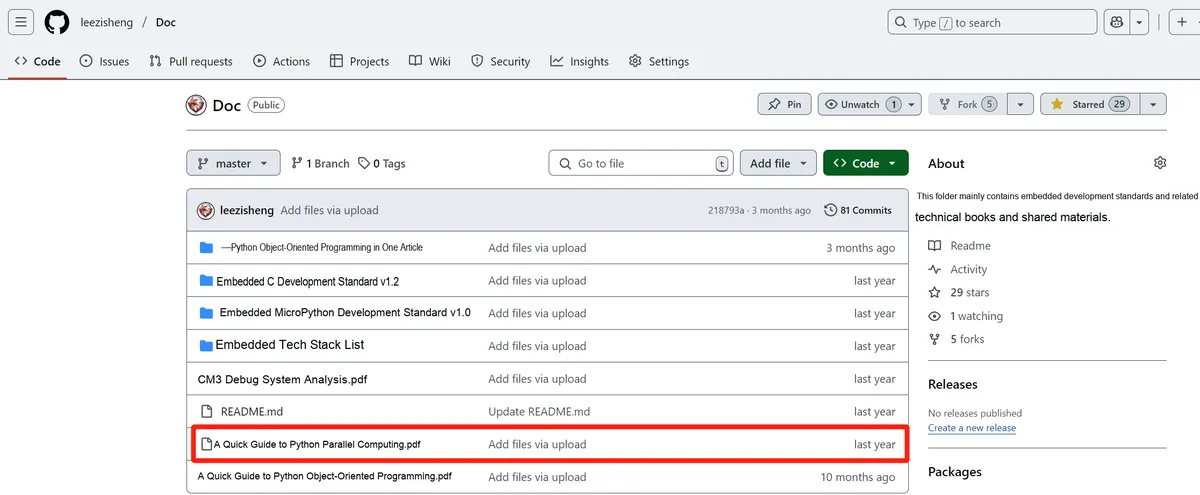
For more information about us, you can refer to the cloud document: Freak Embedded Studio Cloud Docs, or visit our wiki:https://github.com/leezisheng/Doc/wik
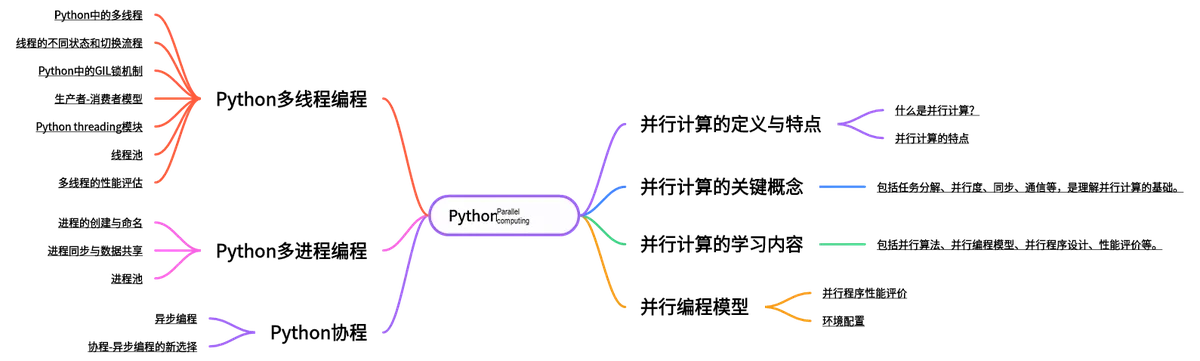
This document is a learning guide on parallel computing and Python concurrent programming, which covers the core knowledge points including the basic concepts of parallel computing, Python multi-threaded programming, multi-process programming and coroutine programming:
Body Text
Prior to reading this document, it should be noted that this document does not cover the explanation of knowledge points such as computer architecture (including SISD, MISD, etc.), memory organization, massive parallel processing (MPP), and heterogeneous computing. It mainly focuses on the implementation and application of knowledge points including multithreaded concurrency, multiprocess parallelism, task synchronization, message transmission, debugging and testing based on the Python language.
1.1 What Is Parallel Computing? Features of Parallel Computing
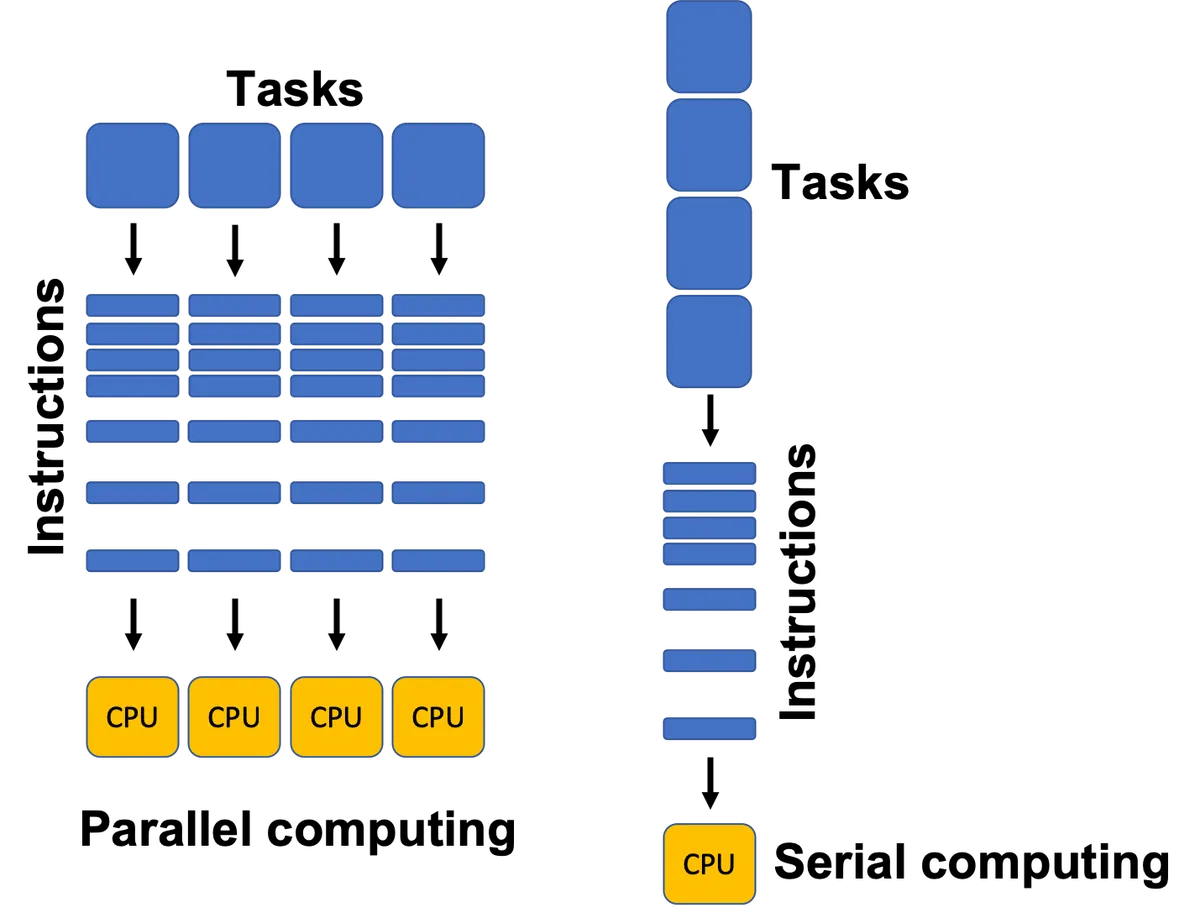
What is traditional serial computing? Traditional software is developed based on the programming concept of serial computing. A serial computing program runs on a standalone machine equipped with a single core (or CPU). A problem to be solved is decomposed into a sequence of independent instructions (instruction streams, which can also be threads). These instruction streams are executed sequentially one after another. At any given moment, only one instruction stream is being executed. In other words, only one thread is running at any time.
Parallel computing, explained in the simplest terms, refers to the use of multiple computing resources (i. e., multiple CPUs) simultaneously to run a program for solving a problem that requires massive computation. A parallel computing program runs on a multi-core (or multi-CPU) computer, or a network composed of multiple computers. For a problem that demands extensive computation, it needs to be broken down into multiple independent parts that can be executed concurrently. The instruction execution streams of different parts can be run on different CPUs at the same time. In other words, multiple threads can be executing at the same point in time.
1.2 Key Concepts of Parallel Computing
Task Parallelism and Data Parallelism: Task parallelism refers to the simultaneous execution of different tasks on multiple processors;Data Parallelism refers to the simultaneous execution of the same operation on multiple processors, but on different subsets of data.
Parallelism: This is a metric that indicates the number of tasks that can be executed in parallel within a given period of time.
Parallel Algorithms and Parallel Programming: A parallel algorithm is an algorithm designed for parallel computing, while parallel programming refers to the process of implementing such algorithms. Parallel programming may involve the use of specific parallel programming languages or parallel processing libraries.
1.3 Learning Content of Parallel Computing
In-depth understanding of parallel computing concepts: In addition to grasping the basic concepts of parallel computing (such as the difference between parallel and serial, the concepts of Data Parallelism and task parallelism, etc.), one should also conduct in-depth research on parallel algorithms and parallel programming models. Learn about various parallel architectures (such as shared memory, distributed memory and hybrid models) as well as parallel programming paradigms (such as message passing, Data Parallelism, task parallelism and stream parallelism).
Write and optimize parallel programs: Use Python's multiprocessing and other libraries to write more complex parallel programs, such as implementing parallel sorting or parallel search algorithms. In addition, learn and practice how to optimize parallel programs, including load balancing, reducing communication overhead, avoiding Synchronization Delay, etc.
Performance Analysis of Parallel Programs: Learn to use specialized tools (such as Python's cProfile module or other performance profiling tools) to analyze the performance of parallel programs. Understand concepts such as parallel efficiency, speedup, and Amdahl's law, and learn how to apply these concepts to evaluate the performance of parallel programs.
Understanding the Challenges and Solutions of Parallel Computing: Gain in-depth insight into the challenges of parallel computing, including data dependency, race conditions, deadlock, parallel overhead, etc. , and learn how to avoid or address these issues. Understand the concepts of synchronization and locking in parallel programming, and learn to use Python's threading or multiprocessing library to handle concurrency problems.
1.4 Parallel Programming Model
Parallel programming models are high-level concepts that describe the design and execution of parallel programs. These models provide programmers with a way to organize and control the computation and communication of parallel programs. There are many different types of parallel programming models, including the following:
Shared Memory Model: In this model, all processors can access the same Memory Space. Processors communicate by reading from and writing to this shared Memory Space. This model is simple and easy to use, but it may require handling issues related to data consistency and synchronization.
Message Passing Model: In this model, each processor has its own Memory Space, and communication between processors is achieved by sending and receiving messages. This model is suitable for use in distributed systems without shared memory.
Data Parallelism Model: In this model, data is divided into multiple segments, each of which is processed independently on a single processor. This model is suitable for processing massive volumes of data where each data segment follows the identical processing procedure.
Task Parallelism Model: In this model, different tasks are assigned to different processors. Each task may need to perform distinct operations and may be interdependent on one another.
Which parallel programming model to choose depends on the nature of the problem and the available hardware resources. Different models may require different programming techniques and tools.
1.5 Performance Evaluation of Parallel Programs
In the process of optimizing program performance, performance profiling is a critical step. It helps you understand how the program runs and identify bottlenecks, so that you can carry out targeted optimization for these bottlenecks.
Python has a built-in module called cProfile, which is a very powerful performance analysis tool. The cProfile module can provide detailed statistics about which parts of your program consume the most time. Using the cProfile module, you can see the number of calls to each function in your program, the time taken per call, and the total running time of each function. This information can help you identify the bottlenecks in your program.
Common performance metrics include:
Parallel Efficiency: Parallel efficiency is an indicator for measuring the performance of parallel programs. It is the ratio of the running time of a serial program to the product of the running time of a parallel program and the number of processors. The ideal value of parallel efficiency is 1, which means that the performance of a parallel program is proportional to the number of processors. However, due to issues such as communication overhead and Synchronization Delay, the actual parallel efficiency is usually lower than 1.
Speedup Ratio: The speedup ratio is another metric for evaluating the performance of parallel programs. It refers to the ratio of the execution time of a serial program to that of a parallel program. Ideally, the speedup ratio should be equal to the number of processors, but in practice, it is usually lower than the number of processors due to overheads such as communication and synchronization.
Amdahl's Law: Amdahl's Law is a theorem that describes the upper bound of the performance of parallel programs. It states that for a given problem, even if we have an unlimited number of processors, our speedup will still have an upper limit due to the serial portion of the program.
1.6 Environment Configuration
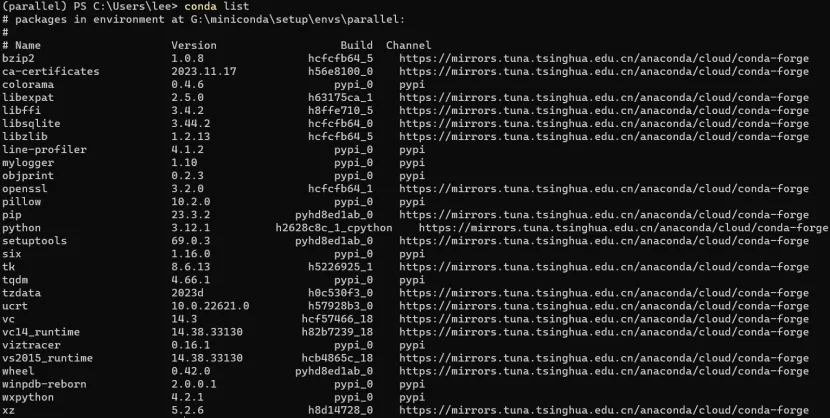
The dependent libraries and their versions required for the sample code in this document are as follows. We only need to use miniconda to configure a basic Python environment: