
Labs / Python OOP

The most beginner-friendly Object Oriented programming tutorial across the entire network: 17 Python implementation of classes and objects - duck typing and "file-like object"

Author: Li Zisheng · Source: FreakStudio open documentation · License: CC BY 4.0

Contents

Abstract:

This paper mainly introduces the basic definition, characteristics and application scenarios of duck typing when creating custom classes in Python, and also lists examples of "file-like object" to illustrate duck typing.

FreakStudio's Blog

Previous Recommendations:

You who study embedded systems still don't know Object Oriented? ?!

The Most Beginner-Friendly Object Oriented Programming Tutorial on the Whole Network: 00 Introduction to Object Oriented Design Methodology

The Most Beginner-Friendly Object Oriented Programming Tutorial on the Whole Network: 01 Basic Concepts of Object Oriented Programming

The Most Beginner-Friendly Object Oriented Programming Tutorial on the Whole Network: 02 Python Implementation of Classes and Objects - Creating Classes with Python

The Most Beginner-Friendly Object Oriented Programming Tutorial on the Whole Network: 03 Python Implementation of Classes and Objects - Adding Attributes to Custom Classes

The Most Beginner-Friendly Object Oriented Programming Tutorial on the Whole Network: 04 Python Implementation of Classes and Objects – Adding Methods to Custom Classes

The Most Beginner-Friendly Object Oriented Programming Tutorial Across the Network: 05 Python Implementation of Classes and Objects - PyCharm Code Tab

The most beginner-friendly Object Oriented programming tutorial on the entire network: 06 Python implementation of classes and objects - data encapsulation of custom classes

The most beginner-friendly Object Oriented programming tutorial across the entire network: 07 Python implementation of classes and objects - type annotations

The Most Beginner-Friendly Object Oriented Programming Tutorial Across the Web: 08 Python Implementation of Classes and Objects - @property Decorator

The Most Beginner-Friendly Object Oriented Programming Tutorial on the Whole Network: 09 Python Implementation of Classes and Objects - Relationships Between Classes

The Most Beginner-Friendly Object Oriented Programming Tutorial Across the Network: 10 Python Implementation of Classes and Objects - Class Inheritance and Liskov Substitution Principle

The Most Beginner-Friendly Object Oriented Programming Tutorial on the Whole Network: 11 Python Implementation of Classes and Objects - Subclass Calling Parent Class Methods

The Most Beginner-Friendly Object Oriented Programming Tutorial on the Whole Internet: 12 Python Implementation of Classes and Objects - Using the logging Module in Python to Output Program Running Logs

The Best Beginner-Friendly Object Oriented Programming Tutorial Across the Network: 13 Python Implementation of Classes and Objects – Installation and Usage of Sourcetrail, a Visual Code Reading Tool

The Most Beginner-Friendly Object Oriented Programming Tutorial on the Whole Network: 14 Python Implementation of Classes and Objects – Static Methods and Class Methods of Classes

The most beginner-friendly Object Oriented programming tutorial across the network: 15 Python implementation of classes and objects - the __slots__ magic method

The Most Beginner-Friendly Object Oriented Programming Tutorial Across the Network: 16 Python Implementation of Classes and Objects - Polymorphism, Method Overriding and Open Closed Principle

More exciting content can be found here:

Speed Up Your Python: A Quick Guide to Python Parallel Computing

Understand the Debugging Principle of CM3 Microcontroller in One Article

After half a month of dedicated work, the comprehensive summary of embedded technology stack is now released

The "Secret Martial Arts Manual" for Computer Science Competitions

Document and Code Acquisition:

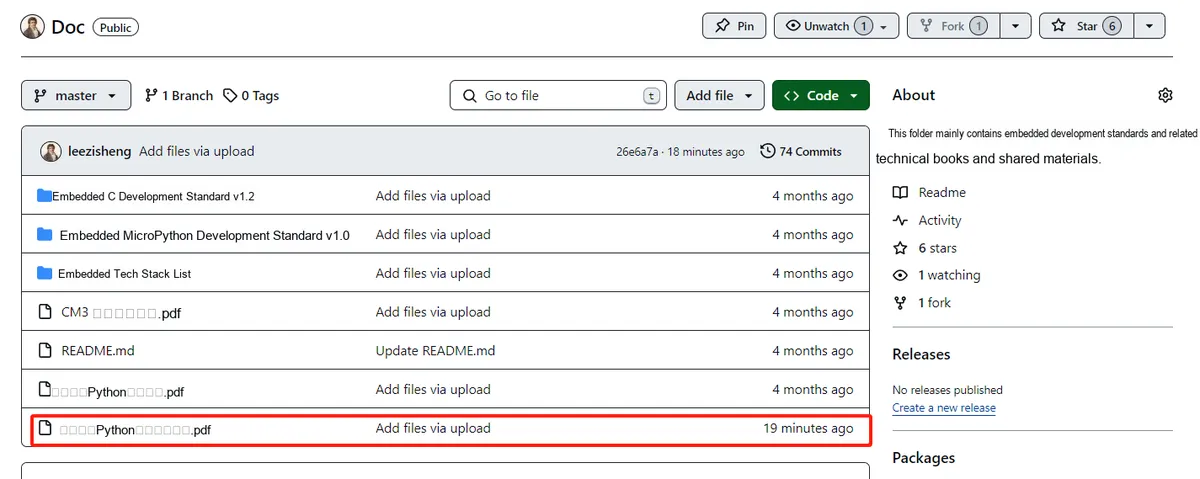
You can download the document via the following link:

https://github.com/leezisheng/Doc
1 0 74 19 1.1

This document mainly introduces how to use Python for Object Oriented programming, and requires readers to have a basic understanding of Python syntax and single-chip microcomputer development. Compared with other blogs or books that explain Python Object Oriented programming, this document is more detailed and focuses on embedded host computer applications, taking the common serial port data transmission and reception, data processing, dynamic graph drawing and other functions between the host computer and the lower computer as application examples. Meanwhile, Sourcetrail code software is used for visual reading of the code to facilitate readers' understanding.

The link to obtain the relevant sample code is as follows:

https://github.com/leezisheng/Python-OOP-Demo

Main Text

Actually, for the IsSerialConnected function, any object that has the RetSerialState method can be passed in, and this polymorphism in Python is usually referred to as duck typing.

The most beginner-friendly Object Oriented programming tutorial across the entire network: 17 Python implementation of classes and objects - duck typing and "file-like object"

"If it walks like a duck and swims like a duck, then it's a duck". We don't care whether it actually inherits from a duck; we only need to know that it can swim or walk. Geese and swans can easily exhibit duck-like behaviors for us, which allows us to create new bird types in future designs without specifying inheritance relationships for waterfowl, and also enables designers to create classes with behaviors completely different from the original intent. For example, a future designer might create a penguin type that can walk and swim, and it also fits the same interface, even though the designer never intended to classify it as a duck.

In duck typing, the focus lies on the behaviors and methods of an object rather than its specific type or class. If an object has the required methods or properties, it can be treated as being of a specific type without the need for explicit declaration or inheritance of that type. This approach allows Python to dynamically determine an object's type at runtime, making code more flexible and concise.

Python's "file-like object" is a kind of duck typing. A real file object has a read () method that returns its content. However, many objects are regarded as "file-like object" as long as they have a read () method. Many functions accept "file-like object" as parameters, and you don't necessarily have to pass a real file object — you can completely pass any object that implements the read () method.
347622978