Contents
Abstract:
This paper mainly introduces the class methods and static methods in classes and objects of Python, as well as their definitions, features, application scenarios and usage methods, and makes a comparison between the two.
Original Link:
Previous Recommendations:
You who are learning embedded systems still don't know Object Oriented? ?!
More exciting content can be found here:
Speed Up Your Python: A Quick Guide to Python Parallel Computing
Understand the Debugging Principle of CM3 Microcontroller in One Article
The "Secret Martial Arts Manual" for Computer Science Competitions
Document and Code Acquisition:
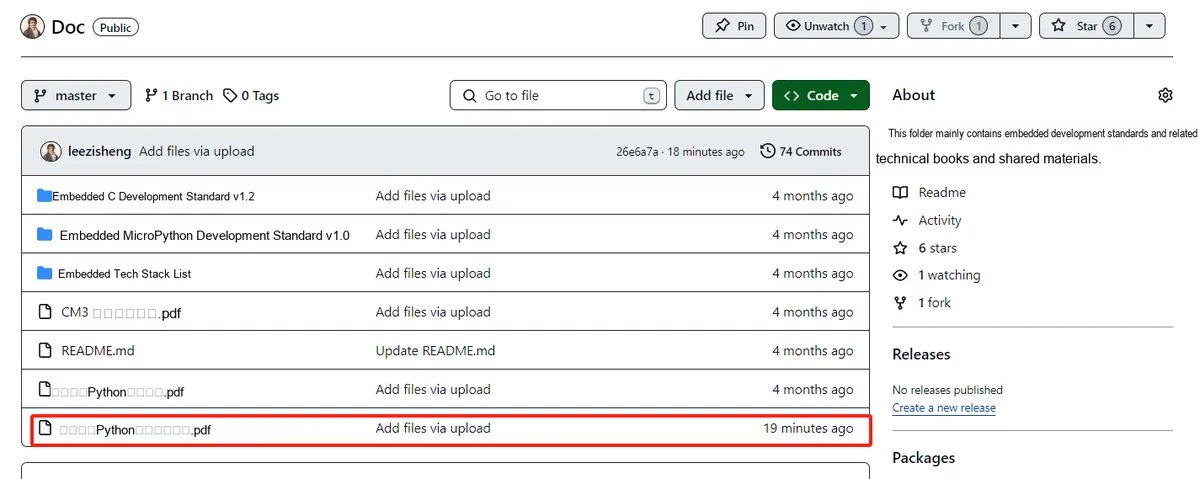
You can download the document via the following link:
https://github.com/leezisheng/Doc
This document mainly introduces how to use Python for Object Oriented programming, and requires readers to have a basic understanding of Python syntax and single-chip microcomputer development. Compared with other blogs or books that explain Python Object Oriented programming, this document is more detailed and focuses on embedded host computer applications, taking the common serial port data transmission and reception, data processing, dynamic graph drawing and other functions between the host computer and the lower computer as application examples. Meanwhile, Sourcetrail code software is used for visual reading of the code to facilitate readers' understanding.
The link to obtain the relevant sample code is as follows:
https://github.com/leezisheng/Python-OOP-Demo
Main Text
static method
Taking the SensorClass class as an example, the methods defined in the class such as InitSensor, StartSensor, and StopSensor are all instance methods; that is to say, these methods are messages sent to an object and all invoke the properties within the object. In practice, not all methods we write in a class need to be instance methods. There are some methods in a class that do not require accessing object properties. For instance, in the InitSensor method, we may need to check whether the current COM port exists, and obviously this method has nothing to do with the sensor object.
As another example, when we define a "Triangle" class, which constructs a triangle by taking three side lengths and provides methods to calculate its perimeter and area, the three given side lengths may not necessarily form a valid triangle object. Therefore, we can first write a method to verify whether the three side lengths can form a triangle. Obviously, this method is not an instance method, because when we call this method, the triangle object has not been created yet (since we do not even know whether the three sides can form a triangle). Thus, this method belongs to the Triangle class rather than to any specific triangle object.We can use static methods to solve this type of problem, and the code is shown below.
    @staticmethod
    # Check whether the sensor ID is valid: here, check whether the ID is between 0 and 99
    def IsTrueID(id:int = 0):
        if id >= 0 and id <= 99:
            return True
        else:
            return False
A static method is essentially the function we have learned. Its only difference from a function is that a static method is defined in the class scope (the class namespace), whereas a function is defined in the scope where the program resides (the global namespace). A static method has no special parameters such as self or cls, so the Python interpreter will not perform any class or object binding on the parameters it contains. Precisely because of this, no class attributes or class methods can be called within a class's static method.Here we define the static method IsPort to determine whether the sensor ID is valid. A static method needs to be decorated with @staticmethod. To call a static method, you can use either the class name or a class object, for example:
    # Set the ID
    id = 1
    # Check whether the ID matches the format
    if SensorClass.IsTrueID(id):
        s = SensorClass()
    else:
        print("Sensor Init False")
class method
Similar to static methods, Python also allows defining class methods within a class. The first parameter of a class method is conventionally named cls, which refers to an object containing information related to the current class (the class itself is also an object, sometimes referred to as the class's metadata object). Through this parameter, we can obtain class-related information and instantiate objects of the class, and Python automatically binds the class itself to the cls parameter (note that what is bound is not the class object). In other words, when calling a class method, we do not need to explicitly pass a value to the cls parameter.
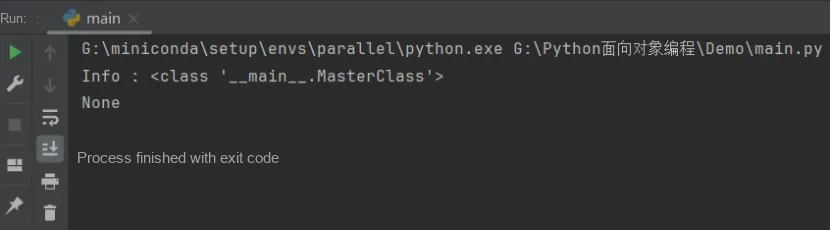
Class methods need to be decorated with the @classmethod decorator. The following is the sample code for defining the class method MasterInfo in MasterClass:
@classmethod
    def MasterInfo(cls):
        print("Info : "+str(cls))

print(MasterClass.MasterInfo())