
Contents
- Introduction
- I. Module Introduction
- 2. Introduction to Main Chips
- 2.1 Chip Overview
- 2.2 Pin Definition
- 2.3 Functional Block Diagram
- 2.4 Performance Parameters
- 2.5 Reference Circuit
- 2.6 Chip Configuration
- 2.7 Communication Interfaces and Related Protocols
- 2.6 Register Definition
- 2.8 PCB Routing Precautions
- III. Circuit Engineering
- 3.1 Circuit Source Engineering
- 3.2 Module Usage Instructions
- 3.3 Application Experiment
- 4. Drivers
- 5. BOM & Recommended Alternative Parts
- VI. Revision History
- VII. Relevant Materials
Introduction
Have you ever encountered such situations: the smart irrigation system misjudges light rain and runs pointlessly, the automatic window closer malfunctions due to dust interference, and the rainfall data on food delivery platforms can only be judged by delivery riders with the naked eye?
For a long time, the "environmental perception" of outdoor smart devices has long been a persistent and intractable problem. Traditional raindrop detection solutions generally have obvious shortcomings:
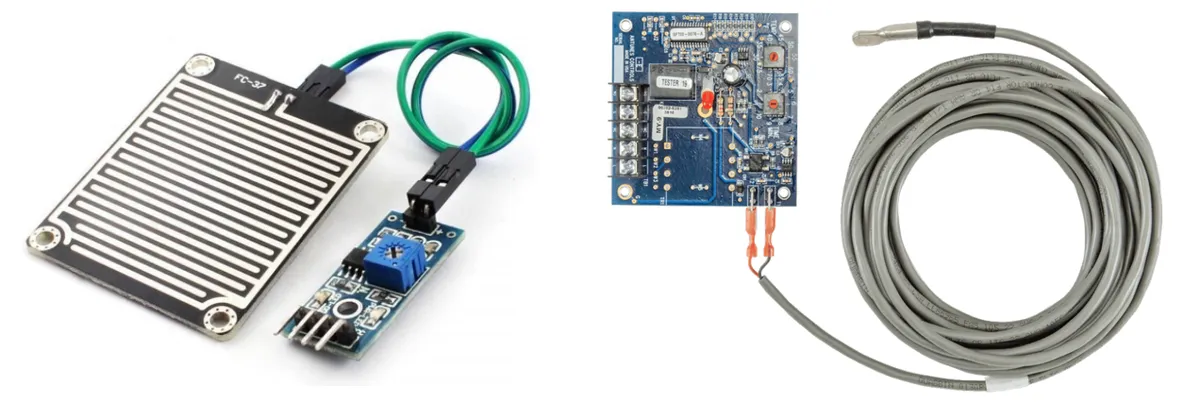
- The "delicate and fragile" resistive sensor relies on rainwater conductivity to determine "whether it is raining", but its metal electrodes are highly vulnerable to dust, corrosion and condensation when exposed outdoors for long periods, leading to malfunction over time; furthermore, it can only make a simple "rain / no rain" judgment, incapable of differentiating rainfall intensity, let alone detecting dust and frost formation.
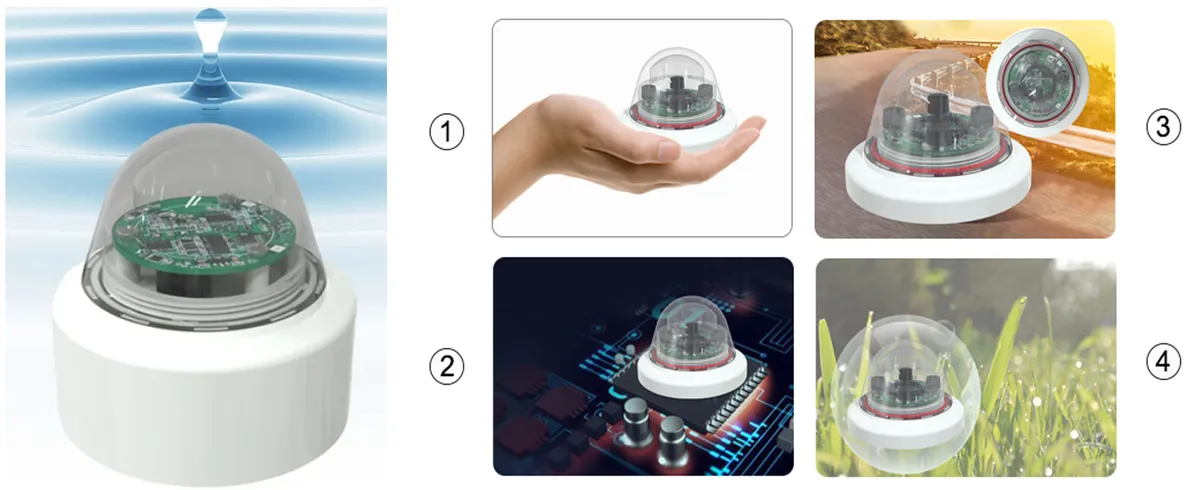
- The "costly" optical solution: while it boasts slightly higher accuracy, it features complex installation, a high price tag, and high susceptibility to interference from occlusions, making it extremely difficult to popularize in consumer-grade devices.
- Generally weak anti-interference capability: Temperature changes and electromagnetic interference can both lead to false triggering, causing the device to "report weather conditions incorrectly".
Launched by Minyuan, the capacitive dust, rain and frost sensor CDS1081 is exactly an "all-round sensing player" designed to address these pain points. It is an intelligent sensor based on capacitive sensing, with a self-developed MCP1081S digital capacitance processing chip as its core — simply put, it perceives the environment through "changes in the dielectric constant of substances": when dust, rain or frost covers the surface, different substances will alter the capacitance value, and the sensor can accurately calculate the thickness of dust, rain and frost through such changes, which is equivalent to equipping the device with a pair of "eyes that can sense thickness".
Its core advantages are as follows:
- ✅ Single chip for three detection modes: Full-capability sensing for dust, rain and frost: It can not only measure rainfall within the range of 0~10mm, but also accurately classify rainfall into multiple levels: light drizzle, light rain, moderate rain, heavy rain and downpour; meanwhile, it can detect dust thickness from 0 to 5mm, and even identify frost formation status, meeting multiple environmental monitoring requirements with just one single sensor.
- ✅ High precision + strong anti-interference, say goodbye to "false weather alerts": With a capacitance resolution of up to 0.001pF and an integrated MCU processor, it can effectively filter out interferences from temperature, condensation, electromagnetism and other factors. Even in humid "Huinantian"(spring damp return days) or outdoor environments with large temperature differences, it can stably output data without triggering false device operations.
- ✅ Through-mount Design + Low Cost, Ultra-Flexible Integration: It supports installation through non-metallic media ranging from 0 to 3mm, eliminating the need for direct outdoor exposure — it works seamlessly with a plastic enclosure, which not only protects the sensor but also reduces the complexity of waterproof design. Meanwhile, the module comes at a low cost, features a simple and easy-to-integrate UART interface, and can be effortlessly adapted for both consumer-grade products and industrial equipment.
- ✅ Low power consumption + wide temperature tolerance, durable even in outdoor environments: Operating voltage ranges from 2V to 5.5V, power consumption is only 4mA at 5V, and it also supports a wide temperature Scope of Work of -40℃ to + 85℃, enabling stable operation in scenarios ranging from sweltering outdoors to frigid northern regions.
It can be applied to the following scenarios:
- 🏠 Smart Home: Making Control "Weather-Aware"
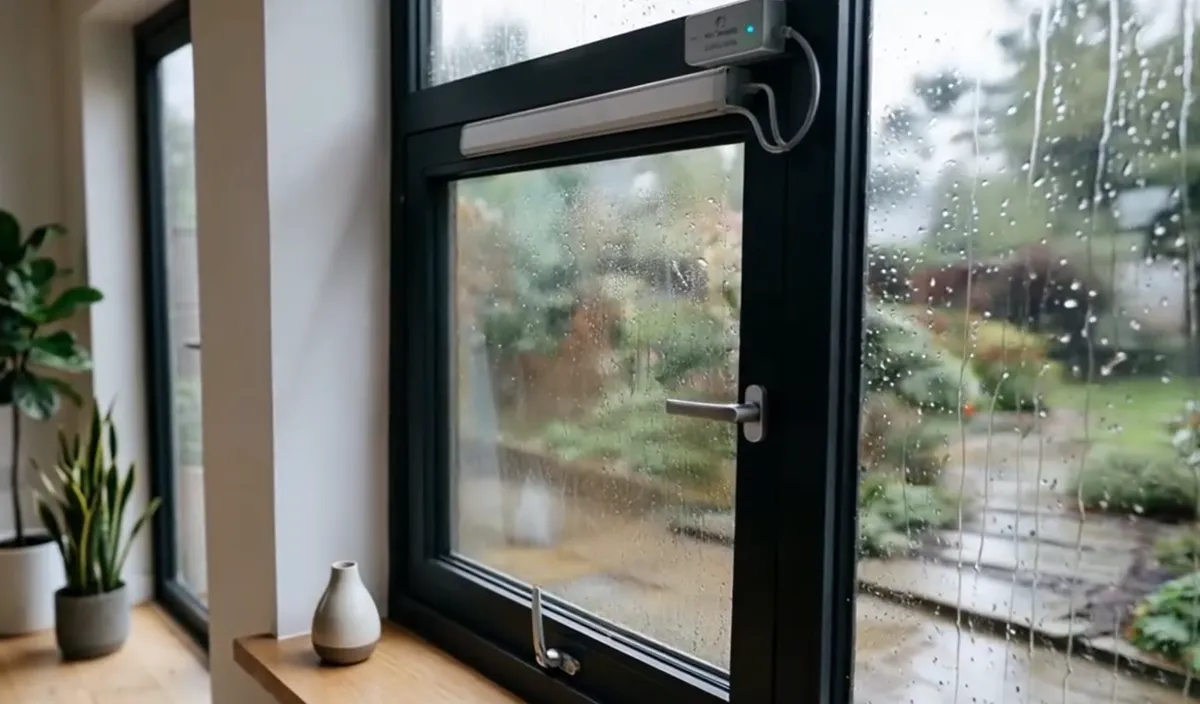
- Automatic window closer: No more worries about forgetting to close the windows when it rains while you're out. It automatically triggers window closing once the sensor detects rainfall, and can also adjust its operating logic based on rainfall intensity — for example, it won't activate during light drizzles, and only performs the closing action when there is heavy rain.
- Smart Irrigation System: It adjusts the irrigation schedule based on real-time rainfall, automatically pauses on rainy days, and supplies water as needed on sunny days. It saves water and frees you from worries, putting an end to the extensive "fixed-time watering" mode.
- 🛵 Outdoor Mobility: Making Dispatch Smarter
- Food delivery / courier e-bikes: After sensors are installed, they can postback rainfall data from different areas. The platform can optimize delivery scheduling based on such data, and riders can also predict road conditions in advance to reduce delivery risks in rainy weather.

- 🏭 Industry & Equipment: Make Maintenance Hassle-Free
- Outdoor Industrial Equipment / Air Conditioner Outdoor Units: When the sensor detects that the dust thickness exceeds the standard, it can automatically trigger the cleaning mode, reducing the probability of equipment failure and cutting down manual maintenance costs.
- Dust Box of Cleaning Equipment: When paired with this sensor, the robotic vacuum can detect dust thickness in real time, remind users to clean it in time, and even automatically adjust the cleaning mode to prevent dust box clogging from compromising cleaning performance.
From smart homes and outdoor travel to industrial equipment and cleaning appliances, the capacitive dust, rain and frost sensor CDS1081 uses a tiny capacitive sensor to solve the major challenge of "environment perception" for outdoor devices. It enables smart devices to stop operating by "guessing" and truly understand changes in rain, dust and frost, providing reliable intelligent control solutions for various scenarios.
I. Module Introduction
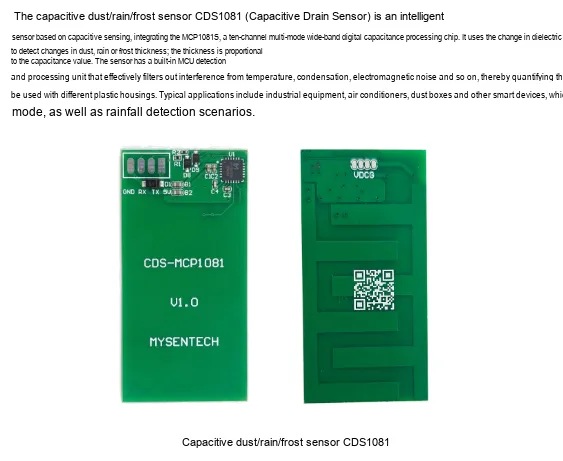
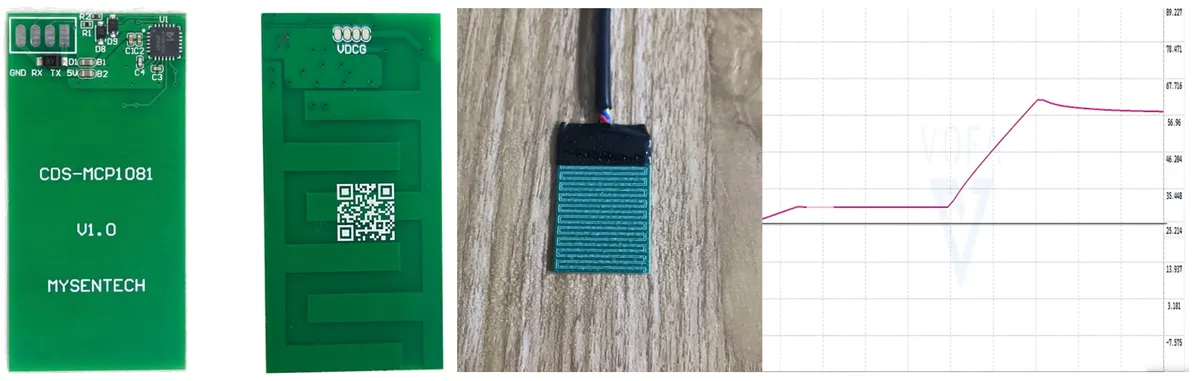
This figure shows the physical appearance of the CDS module, from which the sensing area, board shape and dimensions, and overall structural form can be visually observed.
2. Introduction to Main Chips
2.1 Chip Overview
Minyuan 10-Channel Multi-Mode Broadband Digital Capacitance Processor Chip MCP1081S detects the thickness changes of dust, rain and frost based on the variation of dielectric constant in the presence of such substances, and the thickness of dust, rain and frost is directly proportional to the capacitance value.
2.2 Pin Definition
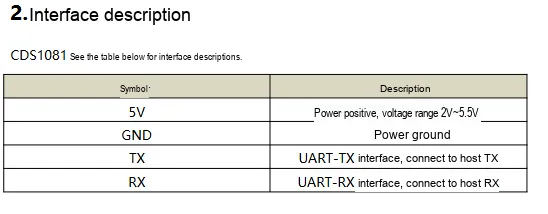
This figure illustrates the pin definitions of the module, which can be used to verify the connection relationships between the power supply and serial port signals.
2.3 Functional Block Diagram
None.
2.4 Performance Parameters
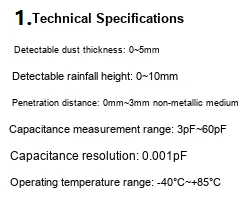
This figure presents the main performance parameters of CDS, including information such as power supply, power consumption and basic measurement capabilities.
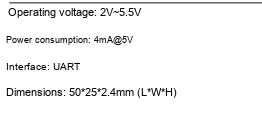
This diagram supplements the specifications and application parameters of the module, facilitating reference during model selection and system design.
2.5 Reference Circuit
None
2.6 Chip Configuration
None.
2.7 Communication Interfaces and Related Protocols
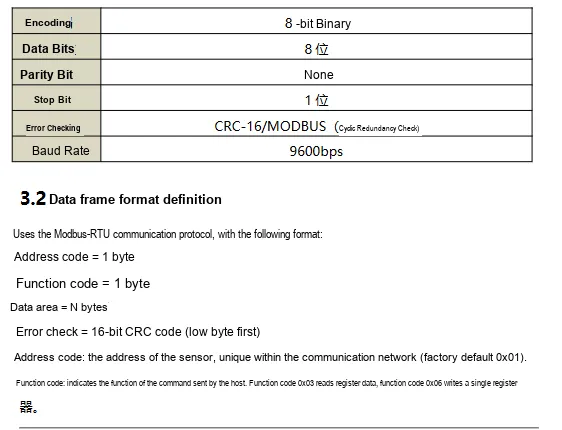
This diagram illustrates the basic parameters and frame format of module communication, which serves as the basis for master-slave communication development.
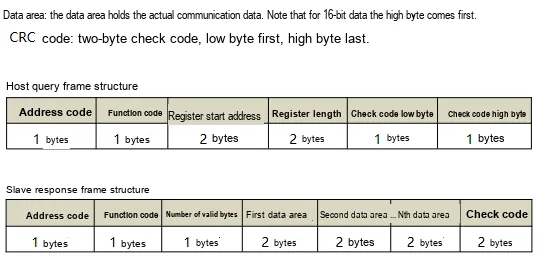
This diagram illustrates communication examples and data organization methods to facilitate understanding of the composition of specific read and write instructions.
2.6 Register Definition
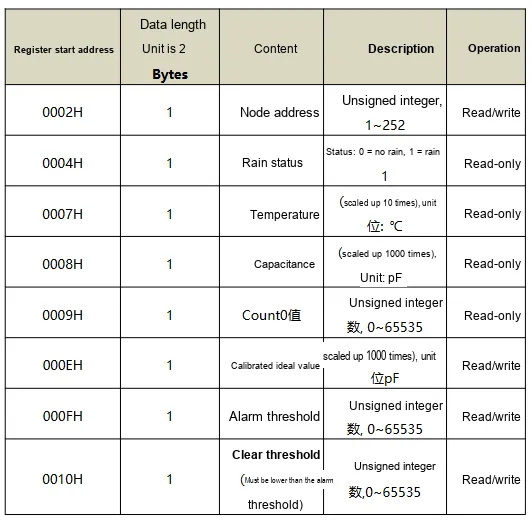
This figure lists the register definitions, which can be used to read measurement values or configure relevant threshold parameters.
2.8 PCB Routing Precautions
None.
III. Circuit Engineering
3.1 Circuit Source Engineering
To obtain the source project of the circuit, please refer to the link below:
https://www.mysentech.com/productinfo/3168524.html
3.2 Module Usage Instructions
3.2.1 Module Test Environment Setup and Notes
Before using this module, set up the test environment as required:
- Conventional test: Indoor environment with room temperature of 25℃±5℃, humidity of 40%~60%, free of strong electromagnetic interference and vibration
- Environmental test: high and low temperature chamber, which can simulate a temperature environment ranging from -40°C to + 85°C
Here, during testing, we can simulate dust, condensation and rain scenarios using just ordinary paper sheets and clean water: simply put, we cover the sensing surface with paper sheets of different thicknesses to simulate dust accumulation, add a small amount of clean water to simulate rain, frost and condensation, and observe whether the values change steadily and linearly with the occlusion and the thickness of the water layer.
3.2.2 Usage of Modbus Poll
Modbus Poll is a universal Modbus master debugging tool compatible with all capacitive sensors in this series that support the Modbus-RTU protocol. It enables quick serial communication debugging, real-time data reading and log export between sensors and computers, serving as a universal host computer tool for verifying sensor functions and collecting test data. The software supports Modbus RTU/ASCII/TCP/IP protocols, is compatible with multiple register types and data formats, and its operation process is universal for the entire series of sensors.
Before use, you need to complete the software installation and activation first. You can download the installation package through official channels; the first launch supports a 30-day trial, and you can also enter a registration code for permanent activation. After the hardware connects the sensor to the computer, open the software and click "Connection" - "Connect", then configure the serial port parameters (Port Number, baud rate, data bit/parity bit/stop bit; this series of sensors defaults to the 9600 Baud, 8N1 format, subject to the specification sheet of the corresponding specific model) in the pop-up window, and confirm to establish a communication connection.
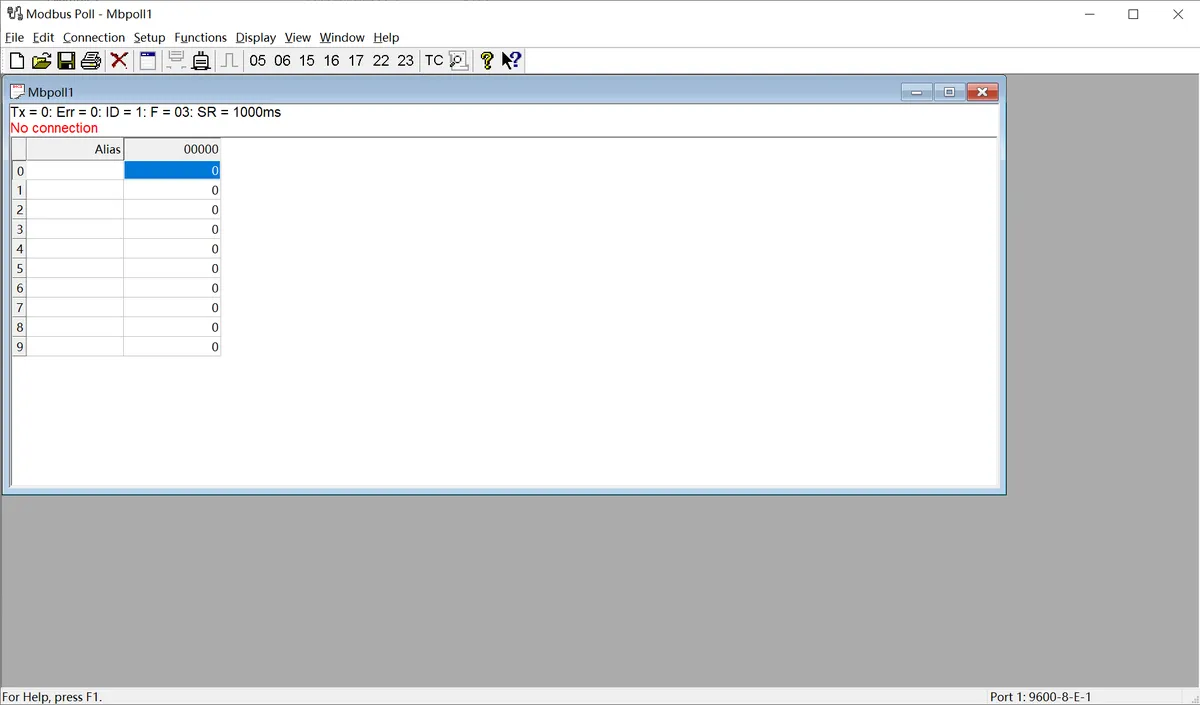
The following is a description of the general operation process:
- Serial Port Connection Configuration: After connecting the sensor to the computer via a USB-to-serial port module, launch the Modbus Poll software, click "Connection" - "Connect" on the menu bar, select the COM Port Number corresponding to the sensor in the pop-up window, and configure the serial port parameters matching the sensor (baud rate, data bits, parity check mode, stop bits; this series of sensors defaults to 9600 Baud, 8N1 format), then confirm to establish a communication connection.
- Import Sensor Configuration File: The software supports importing
. mbppre-configuration files corresponding to various sensor models. These files come with preset register addresses, data formats, and alias definitions, eliminating the need for manual register configuration. Simply open the. mbpfile for the corresponding sensor in the software to automatically load all parameters. Once the connection is established, real-time detection data of the sensor (such as dust/rain/frost thickness values, status flag bits, etc.) will be displayed directly. - Data Logging (Optional): If you need to save test data, you can configure logging rules via the "Setup" - "Excel Log" function. It supports logging data at fixed intervals or with every data update, and allows you to set a maximum number of log entries, facilitating subsequent analysis and verification of sensor data.
The above are the general basic operations of the host computer. For the. mbp preconfiguration files, specific register definitions and special configuration details of different sensor models, please refer to the content in "VII. Related Materials".
3.3 Application Experiment
Here, we use the GraftPort-RP2040 development board for testing, and the capacitive dust, rain and frost sensor CDS uses the UART interface to communicate with the main controller.
Here, we first use the HY2.0-4P connection cable to connect the capacitive dust, rain and frost sensor CDS via the XH2.54-4P to HY2.0-4P interface adapter module to the GraftPort-RP2040 development board's UART0 interface:
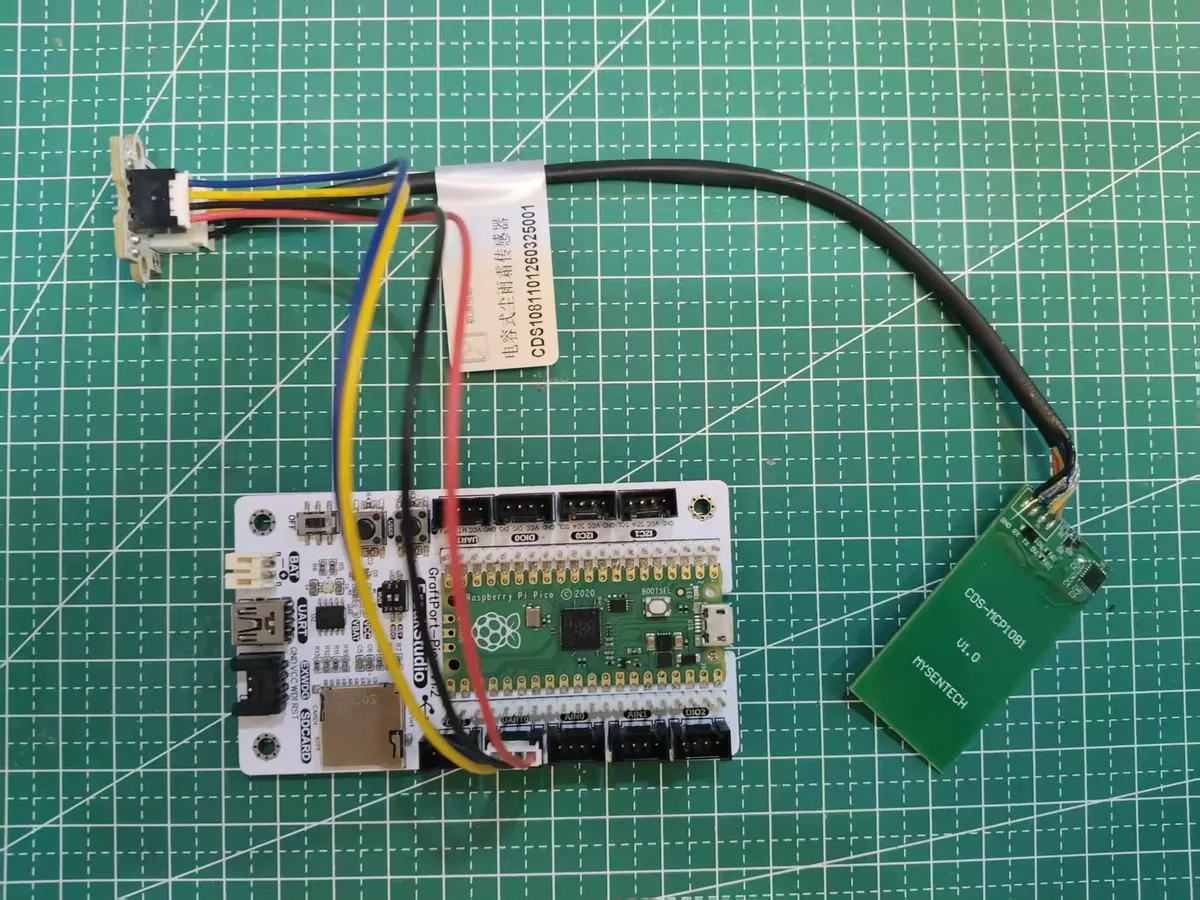
This diagram illustrates the actual wiring method between the CDS module and GraftPort-RP2040 development board.
The module connections are shown in the following table:
Development Board Pins | Module Pins | Description |
Pin 16 |
|
|
Pin 17 |
|
|
Here, we need to search for the relevant driver packages on uPyPI: https://upypi.net/zh/
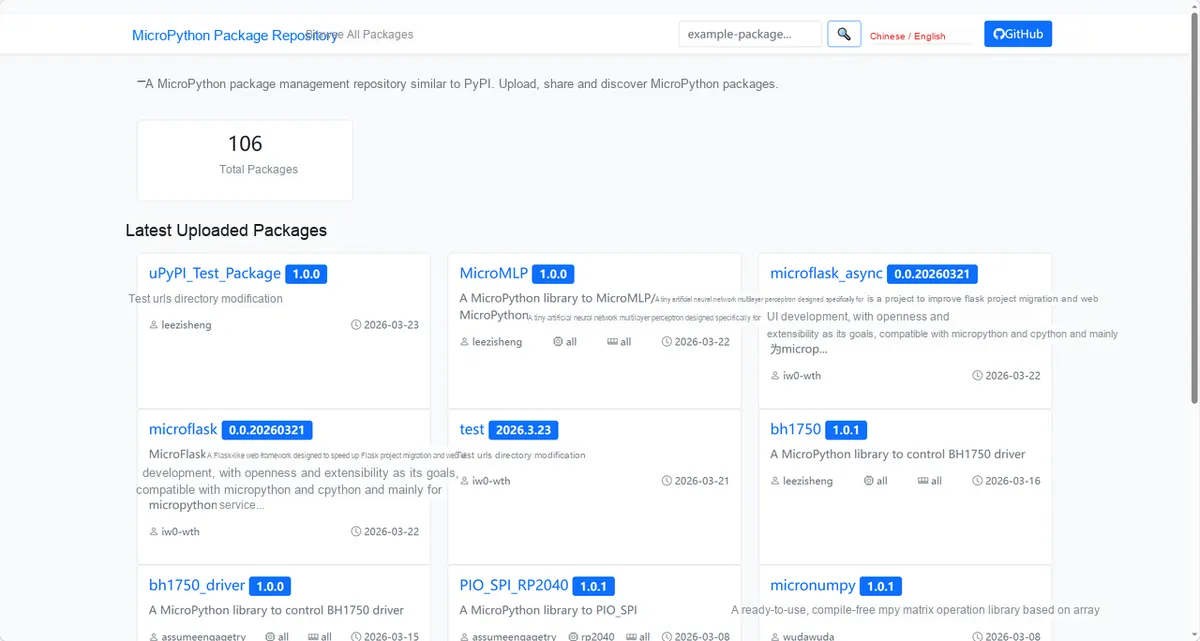
This diagram demonstrates the operation entry for finding sensor driver packages on the uPyPI platform.
Enter cds1081_driver to search, and the following will be displayed:
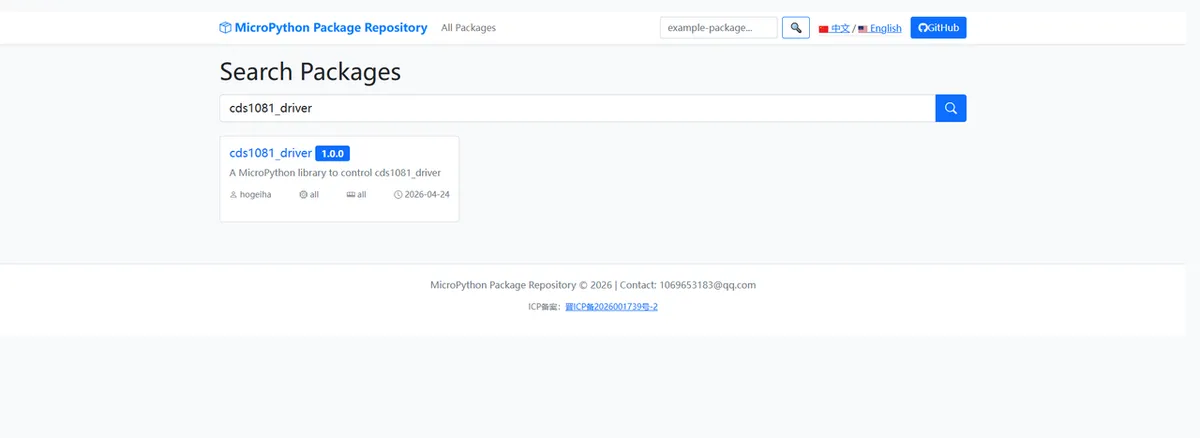
This figure shows the search results for cds1081_driver, which are used to confirm the name and version of the driver package.
Click to copy the local installation command:
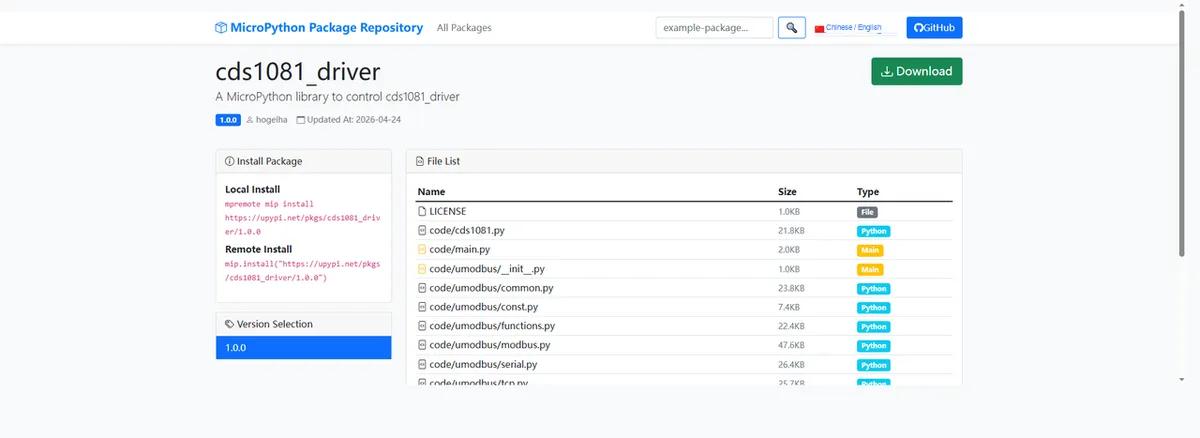
This figure shows the interface for copying the local installation command, which facilitates quick driver deployment.
Import the module driver library code via the mip tool. Below are the usage commands for the mpremote tool:
mpremote mip install https://upypi.net/pkgs/cds1081_driver/1.0.0After importing the driver code for the capacitive dust, rain and frost sensor CDS-MicroPython, copy the following main.py code into our project:
# Python env   : MicroPython v1.23.0
# -*- coding: utf-8 -*-
# @Time    : 2025/9/8 4:52 PM
# @Author  : hogeiha
# @File    : main.py
# @Description : CDS1081 rain sensor data reading and threshold configuration

# ======================================== Import Modules =========================================

import time
from cds1081 import CDS1081

# ======================================== Global Variables ============================================

# ======================================== Functions ============================================

# ======================================== Custom Classes ============================================

# ======================================== Initialization configuration ===========================================

# Wait for the system to stabilize
time.sleep(3)
# Output initialization complete message
print("FreakStudio: CDS1081 sensor initialized")

# Create CDS1081 sensor object, specifying slave address, UART ID, TX pin and RX pin
sensor = CDS1081(slave_addr=1, uart_id=0, tx_pin=16, rx_pin=17)

# Set capacitance calibration value, scaled up 1000 times, corresponding to 6pF
sensor.set_calibration(6000)
# Set alarm threshold
sensor.set_alarm_threshold(40000)
# Set clear threshold
sensor.set_clear_threshold(20000)

# ========================================  Main Program  ============================================

# Read sensor data in an infinite loop
while True :
    # Print node address
    print("Node address:", sensor.get_node_address())
    # Print rain status
    print("Rain status:", sensor.get_rain_status())
    # Print temperature value
    print("Temperature:", sensor.get_temperature(), "C")
    # Print capacitance value
    print("Capacitance:", sensor.get_capacitance(), "pF")
    # Print Count0 value
    print("Count0 value:", sensor.get_count0())
    # Print calibration ideal value
    print("Calibration ideal value:", sensor.get_calibration_value(), "pF")
    # Print alarm threshold
    print("Alarm threshold:", sensor.get_alarm_threshold())
    # Print clear threshold
    print("Clear threshold:", sensor.get_clear_threshold())
Burn the code, open the terminal, and the output is as follows:
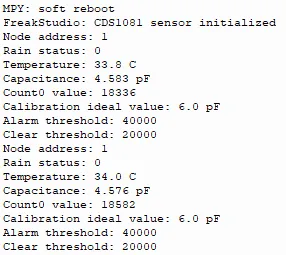
This figure shows the serial port output result after the program runs, from which information such as node address, status and temperature can be seen.
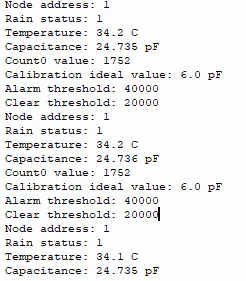
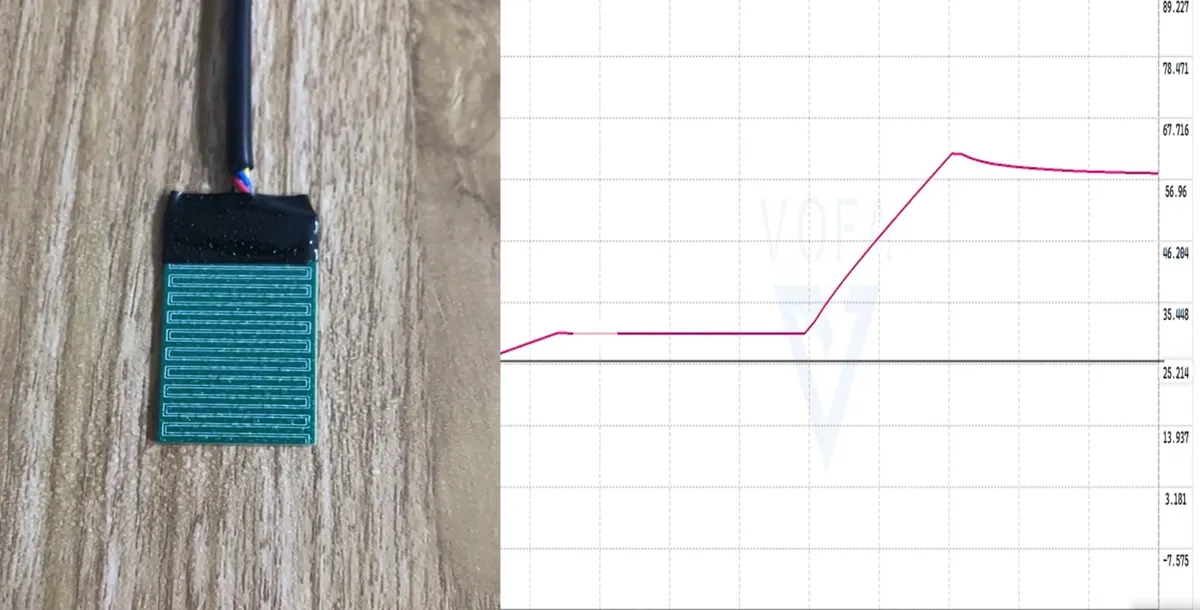
We can observe that after CDS is sprayed with water multiple times, its state gradient exhibits a significant change:
4. Drivers
cds1081_driver.zip 45 KB
5. BOM & Recommended Alternative Parts
None.
VI. Revision History
Document Version | Date of Modification | Modifier | Revised Content |
v1.0 | 2026-04-24 | Hou Junhan | Initialize Document |
v1.1 | 2026-05-20 | Li Zisheng | Add introduction and the usage of 3.2.2 Modbus Poll |
VII. Relevant Materials
CDS1081 Capacitive Dust, Rain and Frost Sensor Product Introduction-Minyuan 202603-2.pdf 765 KB
Modbus+Poll Host Software User Guide-Minyuan 20250102(1).pdf 355 KB
CDS Host Software Modbus+Poll Query Configuration File.mbp 1 KB
Modbus+Poll.rar 1.8 MB