
A beginner-friendly FAQ on Idea, Proof of Concept, Prototype, EVT, DVT, PVT and Mass Production — what each stage means, what you receive, and what it may cost.
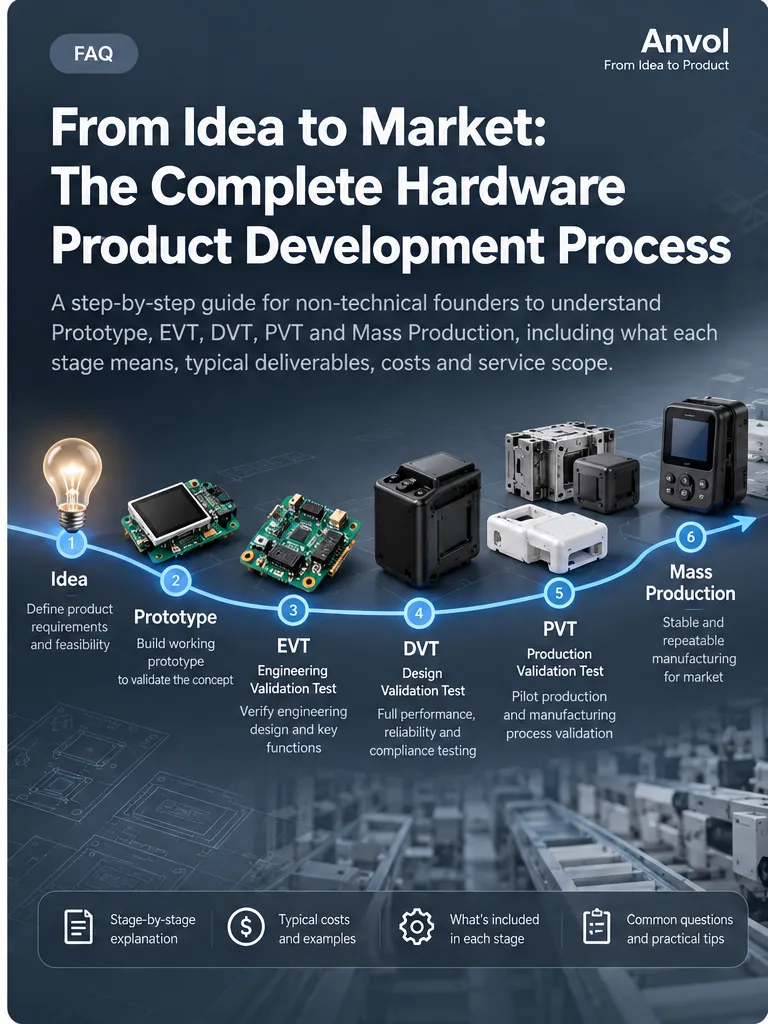
Quick answer: Start by defining who the product is for and what it must do. Build a prototype to validate the concept. Use engineering and design validation to address performance, reliability and market requirements. Verify the factory process in a pilot run. Then move into repeatable production. Not every project needs the same schedule or a rigid sequence, but the risks still need to be addressed.
FAQ 1. I only have an idea. Can a hardware development company help me?
Yes. You do not need to know PCB design, programming or manufacturing to start the discussion.
Imagine you want to create a wearable timer for nurses: a small screen, buttons, rechargeable battery, audible alerts and a cleanable enclosure. Before an engineer can quote accurately, the team needs to turn that concept into a set of decisions:
- What exact tasks should the timer perform?
- What are the target dimensions, weight and operating time?
- Does it work offline? Does it need a phone or cloud connection?
- Is it touch-controlled, button-controlled or both?
- How will users clean, charge, attach and maintain it?
- Where will it be used and sold?
- What is the intended retail price and first production quantity?
- Which requirements are essential for the first demonstration and which can wait?
The result is often a PRD (Product Requirements Document): a written agreement on functions, key specifications and acceptance criteria. If the technology is unusually uncertain, the team may first run a PoC (Proof of Concept) to test one high-risk feature.
Typical deliverables: PRD, concept architecture, technical risk list, initial BOM assumptions and a staged development plan.
Typical fees: an initial conversation may be free; structured feasibility work may cost hundreds to thousands of USD or more for specialized research.
Exit condition: the core requirements and major unknowns are sufficiently defined to plan a prototype.
FAQ 2. What exactly is a prototype?
A prototype is a real device or model intended to test an idea. It may be a rough circuit on a development board, a custom PCB with a 3D-printed case, or an appearance-focused model that does not yet contain final electronics.
There are several useful forms:
| Form | What it proves | What it may not prove |
|---|---|---|
| Proof-of-concept bench demo | One difficult sensor, algorithm or technical principle works | Whole product integration |
| Functional prototype | Main functions run on physical hardware | Final dimensions, appearance or reliability |
| Appearance model | Shape, ergonomics and visual design | Actual electronic performance |
| Integrated prototype | Hardware, software and enclosure work together | Production consistency, complete compliance |
The fastest prototype often uses known components. That can be the right decision even if a later commercial design needs a smaller PCB, more efficient power system or different processor.
Prototype example: a compact music device
An early unit may contain a mature MCU board, display module, buttons, speaker amplifier, storage interface, battery and a 3D-printed enclosure. Users can try the controls and listen to audio. This is a meaningful milestone — not a declaration of mass-production readiness.
Typical work: component selection, hardware/firmware development, mechanical prototype, integration and basic functional tests.
Typical deliverables: agreed number of units, available design files, demo/test evidence, known issues and recommended next steps.
Typical cost: a simple small-device prototype can be in the low thousands of USD; complex connected, Linux-based or robotic products can run into tens of thousands or more.
Exit condition: essential demonstrations pass and customer feedback can guide the next investment.
FAQ 3. Can I use the prototype for fundraising, presales or user testing?
Often, yes — that is one of the most valuable reasons to build it. A working demo can help explain the product to investors, show its real behavior and gather usability feedback before major tooling investment.
However, clearly identify what is simulated, unfinished or still under development. Do not describe an engineering sample as certified, shipping-ready or fully validated unless that is true. Presales also create delivery, refund and compliance obligations that must be assessed separately.
An early founder should ask: Do customers want this product at the price it would need to sell for? before spending heavily on tooling and production readiness.
FAQ 4. What is EVT and how is it different from a prototype?
EVT = Engineering Validation Test.
A prototype asks: “Can the concept work?”
EVT asks: “Does our actual engineering design meet its key technical requirements?”
An early prototype might use several development boards with connecting wires. EVT may require consolidating circuits into a custom board, validating the power system, testing signal quality, checking heat and current consumption, and integrating the firmware into a more intentional architecture.
For a music device, EVT tests could include:
- Audio noise and output quality.
- Display performance and responsiveness.
- Button scanning and input latency.
- Peak current, charging and battery behavior.
- Component placement, heat and connector reliability.
- Firmware stability and recovery from common errors.
- Early manufacturing and supply-chain risks.
Typical work: schematic/PCB revisions, firmware integration, engineering measurements, troubleshooting and design reviews.
Typical deliverables: EVT samples, revised files, test plan/results, open-issue list and initial cost/manufacturing assessment.
Typical costs: engineering labor, revised boards and samples, fixtures and targeted tests; can range from a modest optimization budget to substantial redevelopment.
Exit condition: agreed critical engineering requirements pass, high-risk defects are addressed and remaining risks are visible.
EVT is not a license to bill twice for prior work. If prototype engineering already achieved a requirement, the next quote should reuse and credit that progress.
FAQ 5. What is DVT? Is this where the product becomes “commercial grade”?
DVT = Design Validation Test.
DVT asks: “Does the near-final product design satisfy the full agreed product specification and applicable reliability/compliance requirements?”
The PCB, enclosure, battery, connectors, control positions, materials and firmware are approaching their intended production versions. Depending on the product, testing can involve:
- Required functional and performance specifications.
- Temperature/humidity exposure and operating life.
- Mechanical strength, drop/vibration and button life.
- Power, battery and charging safety.
- EMC pre-compliance and design corrections.
- Radio and other market-access requirements.
- Fit, finish, dimensional consistency and assembly tolerances.
- Extended software reliability and failure recovery.
The test list depends on the actual device. A low-risk desk gadget, medical device, radio product and industrial machine will not have identical DVT plans.
Where do injection molds fit?
Production-intent enclosures often enter the picture around the DVT planning and validation period. A team may review manufacturability before authorizing expensive tooling; trial molded parts can then be validated and corrected. Tooling and DVT are often overlapping activities, not necessarily a strict finish-one-then-start-the-other sequence.
Typical work: design validation plan, reliability testing, final design fixes, production-material evaluation and compliance coordination.
Typical deliverables: near-final samples, test reports, tracked defects, updated manufacturing data and design-release decision.
Typical costs: engineering/testing + sample builds; separate line items may include molds, independent laboratories and certification-related work.
Exit condition: agreed design verification/validation evidence is sufficient to release the product for process qualification.
Important: CE is not one universal purchased certificate; specific EU requirements depend on the product. U.S. radio equipment may need FCC authorization. Products used in healthcare require intended-use and regulatory analysis; a timer is not automatically or categorically a regulated medical device simply because it is used by a nurse.
FAQ 6. What is PVT, and why test the factory after testing the design?
PVT = Production Validation Test.
A highly skilled engineer can hand-build three excellent devices while a factory struggles to make 300 consistently. That is why PVT focuses on the manufacturing process, rather than just the product design.
During PVT, the team may:
- Verify assembly sequence and work instructions.
- Prepare programming and automated functional-test fixtures.
- Confirm component traceability, revision control and approved substitutions.
- Train production operators and review safety steps.
- Run an agreed pilot lot (for example 30, 50 or 100 units where appropriate).
- Inspect cosmetic/functional defects and analyze first-pass yield.
- Correct assembly issues and repeat selected checks.
- Review production capacity, process controls and acceptance metrics.
What is yield?
If 95 out of 100 devices pass the specified tests on the first attempt, the first-pass yield (FPY) is 95%. That is not the same as final shipment yield after rework. Whether 95% is acceptable depends on the product, defect types and agreement; no universal PVT pass threshold exists.
Typical deliverables: pilot units, build records, first-pass and final yield, work instructions, test setup, defect analysis, process changes and a production-readiness recommendation.
Typical costs: production engineering, fixture/tool development, pilot-run materials, assembly, test and troubleshooting.
Exit condition: the defined manufacturing process has demonstrated sufficient repeatability, quality and throughput at the planned scale.
FAQ 7. What happens in MP (mass production)? Do I still pay development fees?
MP = Mass Production (or regular production). You issue a production order to manufacture a defined quantity against the approved version and quality requirements.
The recurring purchase price generally covers components, PCB/PCBA, mechanical parts, assembly, programming, testing, quality checks and any included packaging. Shipping, import costs or other services may be quoted separately.
Normally you do not pay for a new PCB design or a new mold on every reorder when the design/tool is unchanged and already paid for. But new firmware features, a component end-of-life change, mold repair, factory transfer or a required compliance update may create fresh engineering costs.
Example hypothetical unit-price tiers:
| Order quantity | Example manufacturing price / unit |
|---|---|
| 100 | $80 |
| 500 | $65 |
| 1,000 | $55 |
| 5,000 | $48 |
| 10,000 | $45 |
These figures are only a teaching example. They exclude the allocation of earlier R&D and tooling, and they do not mean the 10,000-unit price is available on a 100-unit order.
FAQ 8. Can I skip EVT, DVT or PVT to save money?
You can sometimes combine activities, shorten documentation or scale the test plan to risk. A simple product based on a mature design may not need a separate contract and sample batch named EVT, DVT and PVT. But skipping a label does not remove the underlying engineering, safety and legal responsibilities.
A sensible principle is:
Remove duplicated effort, not essential evidence.
The right validation plan depends on product risk, target markets, reliability expectations, change history and scale. Battery-powered, wireless, medical, automotive, safety-critical and high-reliability products may require much deeper validation.
FAQ 9. When should I use 3D printing, silicone molds or injection molding?
Early design: 3D printing is flexible and requires no injection mold; CNC is especially useful for precision or metal parts.
Small runs: silicone-mold vacuum casting may be appropriate for appearance parts or limited batches.
Repeated stable production: injection molding may reduce recurring plastic-part cost after a larger initial tooling investment.
Soft silicone seals/buttons: these may require separate silicone-material production techniques and tooling.
There is no universal order quantity where a steel mold suddenly becomes mandatory. Compare design stability, required material, mechanical performance, total lifetime volume and the true break-even quantity.
FAQ 10. What does a full journey cost? Show me one realistic budget structure.
For clarity, here is a completely hypothetical compact electronics project using a mature controller, display, battery and a plastic housing. Assume an eventual 1,000-unit order.
| Stage / cost | Illustration |
|---|---|
| Requirements / feasibility | $500 |
| Functional prototype, initial samples | $5,000 |
| EVT engineering and test builds | $6,000 |
| DVT engineering and reliability | $8,000 |
| Injection tooling | $8,000 |
| PVT manufacturing preparation and pilot engineering | $5,000 |
| Applicable external testing / certification allowance | $4,000 |
| Pre-production program subtotal | $36,500 |
| First 1,000 units at hypothetical $50/unit | $50,000 |
| Combined illustrative subtotal | $86,500 |
If all prior spending were assigned to that first 1,000 units, the resulting program cost would be $86.50 per unit before extra freight, import duties, tax, sales-channel costs and additional reserves. It would not be the repeat-order factory price. The model is not a promise that such a product can be designed and fully certified for these numbers.
For a complex robot or custom Linux system, even the first prototype may cost more than the entire pre-production illustration. For a mature simple product with reusable engineering work, the program may be substantially less.
FAQ 11. What can I do with $5,000, $10,000 or $50,000?
About $5,000: for the right low-complexity project, prioritize a functional demonstrator and user research, not a promise of full commercial readiness.
About $10,000: for selected small devices, an integrated prototype, modest improvements and a few low-volume user-test units may be possible.
About $50,000: some simpler products could progress through significant production preparation; a difficult product may still be in early engineering.
No budget alone determines the development stage. Define the product and evidence required before selecting the spending plan.
FAQ 12. I already have a PCB, CAD model or firmware. Must I start over?
No. A responsible engineering partner should review the materials you already have and establish what is usable, what needs verification and what must change.
Useful items to share include:
- Current PRD or feature list.
- Schematics, PCB source, Gerbers and BOM.
- Firmware source, build instructions and licenses.
- Mechanical CAD and enclosure drawings.
- Photos or videos of working hardware.
- Known bugs, test results and certification documentation.
- Target quantity, markets, timeline and budget.
You may already have substantial prototype or EVT work completed. The next quote should be based on the remaining gaps, not a blanket assumption that the project restarts at Idea.
FAQ 13. How do I know when to approve and pay for the next stage?
Use milestone acceptance criteria, not just a date or a stage label:
| Milestone | Evidence to request before approval |
|---|---|
| Idea / PRD | Signed requirements, explicit assumptions and prioritized risks |
| Prototype | Demonstrated required functions, delivered samples and known-issue log |
| EVT | Test data against critical technical specifications, revised engineering files |
| DVT | Defined design/reliability test results, design-release and compliance plan |
| PVT | Pilot-build results, process documentation, yield and readiness review |
| MP | Released production revision, inspection plan, purchase order and delivery terms |
A sensible phased contract identifies the work, number of samples, files delivered, acceptance procedure, ownership and what triggers a change request.
FAQ 14. What are the most common first-time founder mistakes?
Mistake: “My prototype works, so it is ready to sell.” A demonstration alone does not establish reliability, regulatory compliance or production readiness.
Mistake: “The factory said $45 per unit, so my first order of 100 will cost $4,500.” Unit prices depend on order quantity; one-time setup costs may be separate.
Mistake: “The development fee should include every future feature.” Engineering scope must be defined; meaningful new functionality may need new budget.
Mistake: “I should order a steel injection mold before users try the device.” Design changes after tooling can be costly. Validate the concept and geometry before committing where practical.
Mistake: “We should do every possible test before speaking to customers.” User and market validation should happen as early as appropriate, while product testing and legal requirements are planned for the intended use.
FAQ 15. What should I ask a hardware engineering company before signing?
- Which stage is this quote actually delivering?
- What exact features and acceptance tests are included?
- How many physical units will I receive?
- Are NRE, BOM, fabrication, assembly and shipping separate line items?
- How many revisions are included, and what counts as a change request?
- What source files, documentation, third-party licenses and IP rights do I receive?
- Are tooling, mold ownership, fixtures and storage/transfer policies clear?
- Are certification, reliability testing and external labs included or excluded?
- Can I request unit-price tiers for 100, 500, 1,000 and 5,000 units?
- What unresolved work remains before we can sell the product?
Final takeaway: a product is not “done” at the first working sample
There are at least three distinct wins:
- Technical success: the core idea functions in real hardware.
- Engineering/manufacturing success: the design and process pass the validation needed for the intended product and scale.
- Commercial success: enough buyers pay an economically sustainable price, and the business can deliver and support them.
You do not need to fund all three on day one. The practical path is to buy the next piece of evidence you need, then use it to make the next investment decision.
About Anvol
Anvol supports early hardware teams with requirements review, electronics, embedded software, mechanical prototyping, physical prototypes and low-volume production coordination. You can engage at the Idea stage, arrive with an existing Arduino/ESP32 prototype, or bring established design files for manufacturing review.
Website: https://anvol.dev/
Companion guide: How Much Does It Cost to Develop a Hardware Product? (provided in the separate FAQ archive)
Editorial note: This is a general educational guide. Stage naming, test scopes and regulatory requirements vary by product and market. Price examples are planning illustrations, not fixed offers.