
A practical FAQ for first-time hardware founders: engineering fees, prototype parts, 3D printing, silicone molds, injection molds, EVT/DVT/PVT, and manufacturing prices.
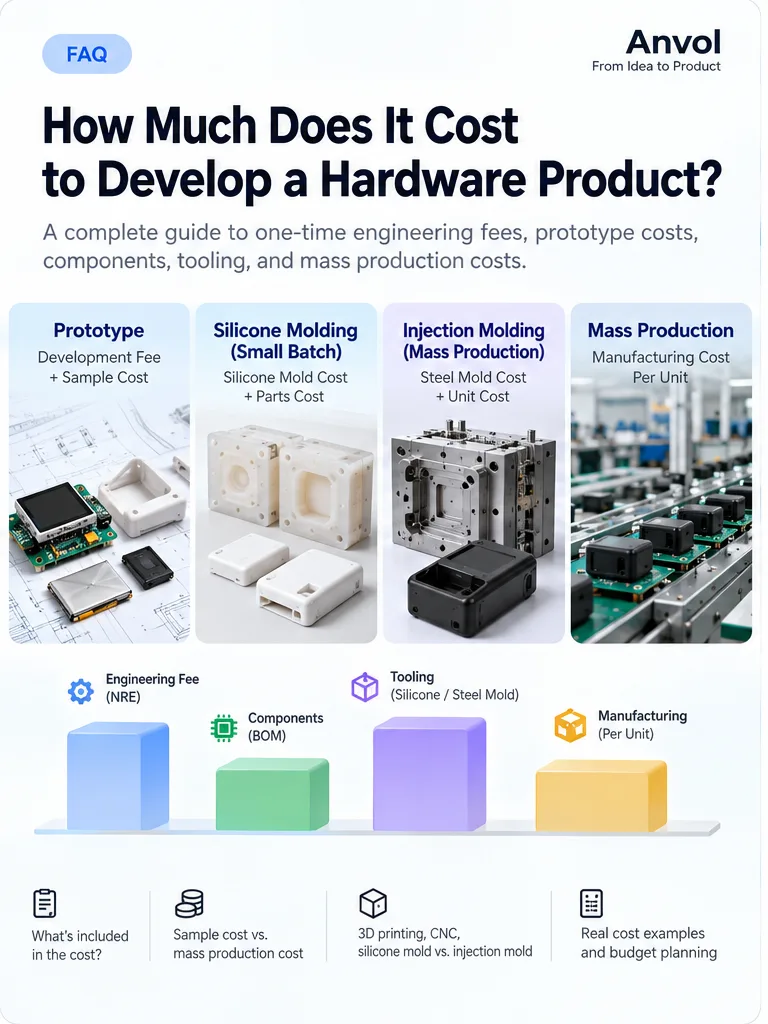
Quick answer: A working prototype and a production-ready product are not the same deliverable. Your budget usually has two parts: one-time costs to design, validate and prepare the product, and per-unit costs to physically manufacture each device. Tooling, certification, testing, shipping and future revisions may add separate costs.
All prices in this article are illustrative planning ranges in USD, not quotations or industry averages. Actual costs depend on complexity, existing work, compliance requirements and order volume.
FAQ 1. Why did one company quote $3,500 and another quote $30,000 for the same product?
Imagine a compact music device with a screen, buttons, battery, speaker and custom enclosure. Three suppliers might propose:
- $3,500: make three functional prototypes using proven components, basic custom electronics and 3D-printed enclosures.
- $25,000: mature the electronics, embedded software and enclosure, perform deeper engineering tests and address design weaknesses.
- $80,000: complete further production engineering, tooling, reliability and compliance work, pilot builds and manufacturing preparation.
Those are different scopes, not three prices for an identical result. A prototype is evidence the idea can work. A production program must also address repeatability, product quality, supply continuity and the requirements of the markets where it will be sold.
Ask every supplier: What precisely is included, what is excluded, and what must happen before I can sell the product?
FAQ 2. What are the main types of hardware development costs?
| Cost category | What you are buying | Usually one-time or recurring? |
|---|---|---|
| Feasibility / PRD | Requirements, architecture, technical risk and early cost assessment | Per study or phase |
| Engineering / NRE | PCB design, embedded software, mechanical design, integration and agreed revisions | One-time for defined scope |
| Prototype parts and fabrication | Components, PCB fabrication, assembly, printing, machining and test labor | Per prototype/build |
| Tooling | Injection mold, silicone mold, fixtures and certain specialized manufacturing tools | Upfront; maintenance or replacement may follow |
| EVT / DVT engineering | Design iterations, verification, reliability testing, test documentation | Per phase / change |
| Compliance / certification | Applicable tests, documentation, lab services and remediation | Per product/version/market as needed |
| PVT / production setup | Production process, work instructions, programming/test fixtures, pilot run | Upfront plus pilot units |
| Mass production | Material, fabrication, assembly, test, packaging | Per unit / order |
| Logistics and tax | Freight, insurance, duties and applicable taxes | Per shipment / jurisdiction |
| Ongoing support | Component substitutions, firmware changes, quality and after-sales engineering | As agreed |
Do not confuse a BOM (parts list) with the full manufactured unit price.
FAQ 3. What is NRE? Why do I pay engineering fees if I only want three devices?
NRE (Non-Recurring Engineering) pays for work that has to happen before the devices can exist: selecting components, designing a PCB, writing firmware, developing mechanical parts, integrating the system, debugging and documenting the result.
That work is often similar whether you initially need three units or thirty. The three physical builds then have their own material, fabrication, assembly and testing costs.
NRE does not mean unlimited future changes. A quote should specify:
- Functional requirements and design assumptions.
- Number and scope of review/iteration cycles.
- Expected deliverables (schematics, PCB source, Gerbers, firmware source, CAD, BOM, test records).
- Acceptance tests and approval milestones.
- Change-request rules and intellectual-property/licensing terms.
If you later add Wi-Fi streaming, a mobile app or a different operating system, that may be new engineering scope, even if your first prototype was accepted.
FAQ 4. What is BOM, and why isn't BOM cost the selling price?
BOM = Bill of Materials: a list of components and quantities. It is a recipe, not a complete manufacturing invoice.
Example: hypothetical compact electronic device
| Item | Example cost per unit |
|---|---|
| MCU and supporting electronics | $12 |
| Display | $8 |
| Battery and charging components | $6 |
| PCB | $4 |
| Connectors, controls and speaker | $5 |
| Electronic BOM subtotal | $35 |
| Enclosure and mechanical fabrication | $10 |
| Assembly and functional test | $5 |
| Illustrative direct unit cost | $50 |
This simple $50 model still excludes potential scrap, yield loss, freight, tariffs, packaging, factory overhead, tooling amortization, warranty reserves and supplier margin. A final consumer retail price must also cover distribution, marketing, returns and the business itself.
A hand-built prototype will often cost more per unit than a repeatable assembly-line build, because its components are purchased in tiny quantities and engineers may assemble or debug it manually.
FAQ 5. What is included in a prototype quote?
A practical prototype quote may include:
- Requirements confirmation and an initial design plan.
- Electronic hardware or development-board integration.
- Embedded firmware / device-side software.
- A functional enclosure (often 3D printed, occasionally CNC machined).
- A stated number of prototypes, e.g. 3 or 5.
- Basic integration testing, a demonstration and agreed technical deliverables.
But do not assume it includes finished production tooling, regulatory approval, full endurance testing, all cloud/mobile software, pilot manufacturing, or final consumer-grade appearance. Those should be explicitly stated if required.
For a simple MCU-based product with mature components, an exploratory prototype may be a few thousand dollars. A Linux-based, multi-board, robot, wireless or highly miniaturized device can cost tens of thousands or more. Product complexity matters more than the word “prototype.”
FAQ 6. Why is a prototype enclosure cheap but an injection mold expensive?
Because designing the shape and manufacturing the tool that repeatedly makes the shape are separate jobs.
| Method | What it means in plain English | Common use | Tooling implications |
|---|---|---|---|
| FDM / SLA 3D printing | Build a part directly from a digital model | 1–20 exploratory units; frequent design changes | No injection mold |
| CNC machining | Cut a shape out of plastic or metal stock | Precision and metal enclosures; low volumes | Usually no injection mold; setup/fixtures may apply |
| Silicone mold / vacuum casting | Copy a master part through a flexible mold, often casting polyurethane resin | Small runs and appearance prototypes | A silicone mold is made; limited useful life |
| Plastic injection molding | Inject molten plastic into a machined production mold | Stable design and repeated production | Upfront production mold, trials and possible revisions |
| LSR silicone molding | Mold silicone material for seals, buttons or flexible parts | Silicone product components | Its own purpose-built tooling |
Important distinction: a silicone mold is a mold made from silicone used to cast parts; a silicone part is a finished item made from silicone. They are not interchangeable. Vacuum-cast parts are often polyurethane, not silicone.
A steel mold may be reused across many production orders, but it is not maintenance-free. Changes to geometry, color/texture strategy, material or cavity count may require modification or a new tool. Establish in writing who owns the mold, where it is kept, the expected lifetime, and the transfer/maintenance policy.
FAQ 7. Should I pay for tooling when I only need 100 devices?
Not necessarily. Compare total cost at your actual volume, not just the cheapest piece price.
A simplified enclosure example:
- Low-volume fabrication: $15 per enclosure, no steel mold.
- Injection molding: $4,000 upfront for the mold, then $2 per enclosure.
| Units | Low-volume fabrication | Injection including mold | Lower hypothetical total |
|---|---|---|---|
| 100 | $1,500 | $4,200 | Low-volume |
| 300 | $4,500 | $4,600 | Low-volume |
| 500 | $7,500 | $5,000 | Injection |
| 1,000 | $15,000 | $6,000 | Injection |
| 10,000 | $150,000 | $24,000 | Injection |
The mathematical break-even point is about 308 units in this deliberately simplified example. In real projects, mold design and trial runs, scrap, materials, finish, shipping, storage and revisions can move the break-even point substantially.
FAQ 8. Why does a company charge me again for EVT, DVT and PVT after a working prototype?
They are not supposed to charge twice for the exact same completed work. They may need to charge for genuinely new validation and manufacturing work.
| Stage | Core question | Examples of additional cost |
|---|---|---|
| Prototype | Can we demonstrate the concept? | Prototype engineering + parts |
| EVT — Engineering Validation Test | Does the integrated engineering design meet key specifications? | PCB/system revisions, engineering samples, functional and performance tests |
| DVT — Design Validation Test | Does the near-final product meet defined design, reliability and applicable compliance requirements? | Reliability program, design fixes, molds, lab tests |
| PVT — Production Validation Test | Can the intended factory process consistently build the product? | Production fixtures, work instructions, pilot units, yield investigation |
| MP — Mass Production | Can confirmed products be produced repeatedly at the agreed cost and quality? | Materials, manufacturing, quality control, logistics |
Some projects combine stages and some prototype programs already cover considerable EVT work. A stage label alone is not justification for another fee. Require a gap analysis showing the work that remains.
FAQ 9. What is a certification fee? Is it the same as an engineering fee?
No. Selling a product may require testing, technical documentation and market-specific conformity work depending on its intended use and features. Examples include EMC, radio, electrical safety, batteries and shipping requirements. In the U.S., some radio products are subject to FCC equipment authorization; in the EU, manufacturers must identify the applicable legislative requirements and conformity procedures for CE-marked products.
There is no universal “CE certificate” that automatically covers all electronic products. Laboratory costs, test failures and design remediation need to be budgeted deliberately. A prototype that turns on has not automatically passed market-access requirements.
For medical, automotive, hazardous or safety-critical equipment, obtain specialized regulatory guidance early.
FAQ 10. If the factory quoted $45 at 10,000 units, can I order 100 units at $45 each?
Not automatically. A quantity-based quote is conditional on purchasing conditions, volume, material pricing and line efficiency. Ask for tiered quotes for 100 / 500 / 1,000 / 5,000 / 10,000 units, with clear inclusions.
Also ask whether the quoted price is:
- Manufacturing unit cost excluding tooling, or
- Fully loaded cost including allocation of one-time spending.
Example: a $40,000 mold spread across 10,000 units adds $4 per unit; allocated across 1,000 units it adds $40 per unit. If the base factory price is $45, the illustrative fully loaded amounts are $49 and $85 respectively, assuming that same $45 manufacturing unit price, which may not actually apply at the lower quantity.
A reusable mold typically does not require repaying the full mold development fee at every reorder, unless the contract or subsequent changes justify additional work.
FAQ 11. How much should I budget in the early stages?
These figures are illustrative screening ranges for relatively small, custom electronics projects, not guaranteed offers. Many complex programs fall well outside them.
| Type of request | Indicative initial budget | Scope considerations |
|---|---|---|
| Single engineering task or review | $300–$1,500 | Narrow technical review, PCB/firmware task |
| Basic functional prototype | $1,500–$3,000 | Mature parts, modest software, limited units |
| Integrated small-device prototype | $3,000–$10,000 | Custom PCB, firmware, enclosure and integration |
| Complex prototype | $10,000–$50,000+ | Advanced computing, robotics, multiple subsystems, significant software |
| EVT/DVT/PVT/production transition | Quote after reviewing existing design | New validation, tooling, production engineering and pilot runs |
| Mass production | Unit-price tiers + one-time costs | Explicit material, test, packaging and delivery terms |
Example $10,000 exploratory program: $4,000 engineering, $1,000 for three prototypes, $1,500 for iteration, $2,000 for 20 low-volume units at $100 each, and $1,500 for testing/shipping/contingency. This might support market validation; it does not imply that full DVT, regulatory approval, production tooling and mass-manufacturing readiness are included.
FAQ 12. What should a supplier quote clearly separate?
A good quote separates:
- Phase and outcome: prototype, EVT, DVT, PVT or production.
- One-time fees: NRE, design revisions, fixtures, molds, certification and production setup.
- Physical builds: quantity, materials, PCB, enclosure, assembly and test.
- Unit price tiers: quantity breaks, MOQ and assumptions.
- Delivery: shipping, incoterms, taxes, customs responsibilities and lead times.
- Acceptance: objective test criteria, exclusions and milestone payments.
- Ownership: source design files, firmware, third-party licenses, tooling, test fixtures and customer IP.
- Change handling: what happens when specifications or components change.
The central rule: You should know what you are paying for now, what you will receive now, and what additional investment may be needed before a commercial launch.
About Anvol
Anvol helps early-stage hardware teams move from incomplete ideas and working prototypes toward engineered devices, prototype builds and repeatable low-volume manufacturing. Projects can start at different stages: an existing PCB does not have to be redesigned from scratch, and a prototype customer does not have to commit to a full production program immediately.
Website: https://anvol.dev/
Companion guide: How Do You Turn a Hardware Idea into a Product You Can Actually Sell? (provided in the separate FAQ archive)
Editorial note: Product examples and pricing are educational; actual project scope, applicable safety rules, manufacturing costs and schedules must be confirmed in a written proposal.