
BlueBerry wireless optogenetic stimulation system
Reference figures from Anvol's engineers for a similar build: second-phase development from $8,000, unit cost $199–299 per module. BlueBerry is a published open-source wireless optogenetic stimulation system for freely moving lab animals (eLife reviewed preprint, design files at optoblueberry.org). A blueberry-sized module combines a Bluetooth LE module, a small microcontroller, a 2-channel MOSFET output, a voltage regulator and a rechargeable coin cell, and drives micro-LED implants through a 2×2 connector; a controller sends stimulation settings such as channel, frequency, pulse width and pulse count. We build this design in small batches for labs, from single replacement modules to complete research kits, and take on second-phase development such as hardware changes, firmware, Bluetooth communication and optical stimulation control.
- Client type: Research labs
- Units: MOQ 3 sets
- Second-phase development: from $8,000
- Unit cost: $199–299 per module
- Stage: Build of a published open-source design; figures are our reference prices
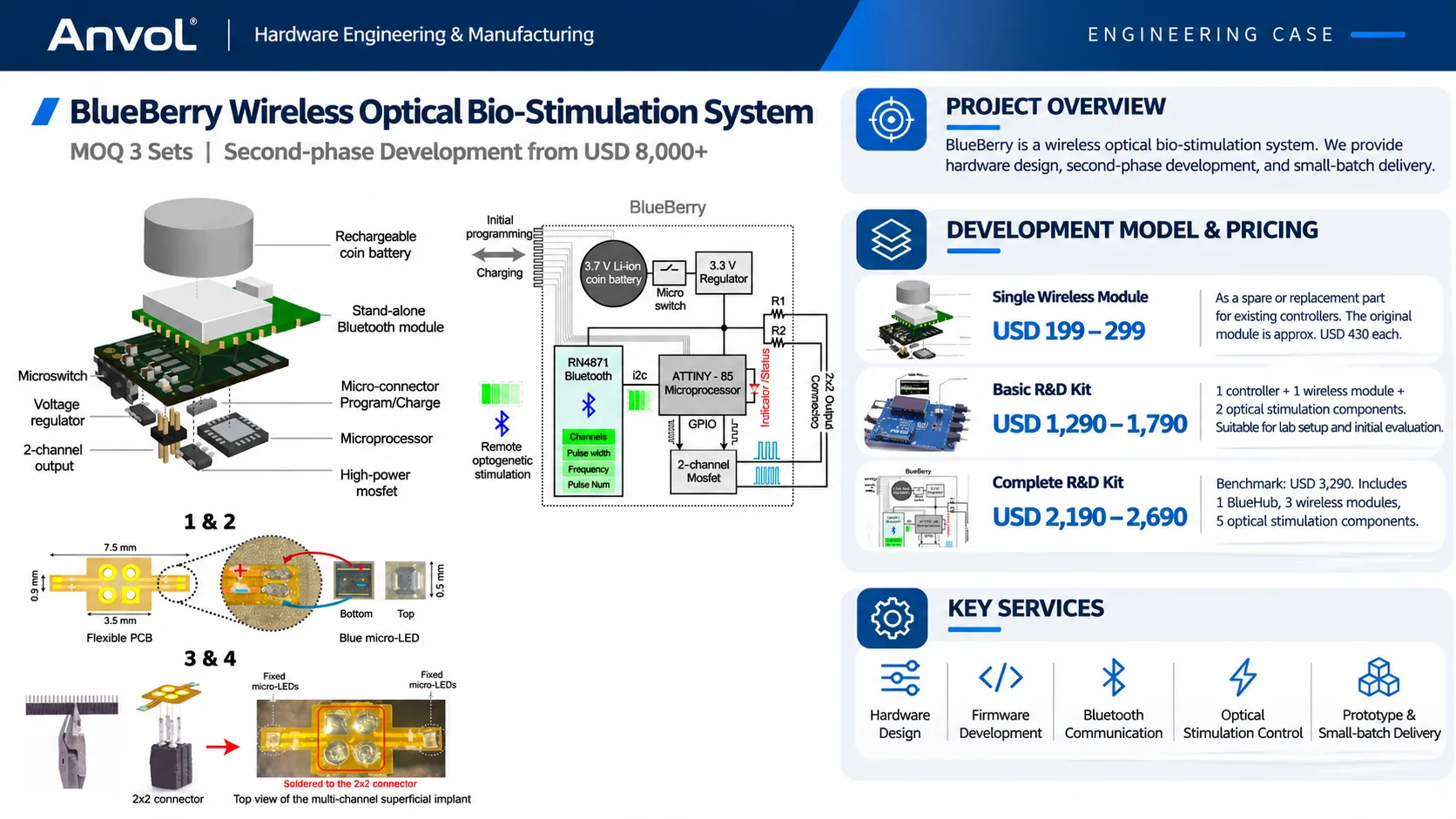
Overview and tech stack
- Project type
- Scientific & Research Equipment
- Wireless module
- Bluetooth LE module, 8-bit microcontroller, 2-channel MOSFET output, rechargeable coin cell
- Control
- Controller sets channel, frequency, pulse width and pulse count per device
- Stimulation
- Micro-LED parts on flexible PCB through a 2×2 connector
- Design basis
- Open-source BlueBerry design (optoblueberry.org); figures on the case sheet are from the eLife paper, CC BY 4.0
Typical scope
- Hardware design changes and small-batch builds
- Firmware development
- Bluetooth communication
- Optical stimulation control
- Prototype and small-batch delivery
What this tech stack can also build
- Wireless optogenetics device for mice
- Spare BlueBerry wireless modules
- Optogenetic stimulation kit for neuroscience labs
- Bluetooth LE LED stimulator
- Closed-loop behaviour-triggered stimulation hardware
- Multi-animal wireless stimulation setup
- Micro-LED flexible PCB implant parts
- TTL-triggered stimulation controller
- Lightweight battery-powered lab device
- Custom firmware for open-source research hardware
- Small-batch build of an open-source lab design
- Head-mounted wireless module for animal research
Commercial reference
- Second-phase development
- from USD 8,000
- Per module or kit
- USD 199–299 per module (single wireless module, as a spare or replacement)
Basic R&D kit (1 controller, 1 wireless module, 2 optical stimulation parts): USD 1,290–1,790
Complete R&D kit (1 controller, 3 wireless modules, 5 optical stimulation parts): USD 2,190–2,690 - Quantity basis
- MOQ 3 sets
- Not included
- Certification such as FCC/CE (quoted separately); shipping and import duties
Reference figures from our engineers for a similar build. Not a past invoice and not a fixed quote; a written quote follows a review of your files.
What to confirm before we quote
- Kit or parts: single modules, a basic or complete research kit, or a custom mix
- Stimulation settings: channels, frequency, pulse width and pulse count you need to set
- Animal and implant: species, how the module is carried, and the micro-LED parts needed
- Second-phase changes: hardware, firmware or Bluetooth changes beyond the open-source design
- Battery: run time per charge you need, and how modules are recharged
Start a similar project
- Send what you have: sketches, a reference product, files or a written idea.
- We review it and list the gaps and open questions.
- You get a written scope and quote.