
Your device needs to keep a screen responsive while processing incoming data. The board has a dual-core chip, so assigning one job to each core sounds like an obvious next step. Before asking someone to rewrite the software, establish what the second core would do independently, and what information the two jobs would still need to share.
For a small team combining working demonstrations into one product prototype, that decision can matter more than the headline clock speed. Two cores create an opportunity to run work in parallel. They do not automatically divide an existing program, shorten a sensor's conversion time or make two routines safe to use the same driver at once.
Take the RP2350 as an example. The Raspberry Pi RP2350 datasheet, in its processor-subsystem chapter, describes two active core positions, each of which can run either an Arm Cortex-M33 or a RISC-V Hazard3 core chosen at boot. The four processor blocks in its diagram are alternatives for those two positions, not four processors running together. The architecture explains the hardware; it says nothing about how fast your combined application will run.
Give the second core a job, not a vague speed target
A useful proposed split might let one task process a block of readings while another handles the interface. Start by describing the inputs and outputs of that processing task. Can it work on a complete block without repeatedly waiting for the interface? Can it return a result without changing objects the display is currently reading? Those questions make the proposed separation concrete enough to evaluate.
Compare that with an application that spends much of its time waiting for the next message. In an August 2025 MicroPython discussion, a Pico 2 W user considered moving work between cores because the interactive console responded slowly. After discussion of the message rate and format, a contributor recommended asynchronous stream reading. The author said they would try it; the thread does not document a completed fix.
The lesson is not that a second core is unnecessary. It is that the communication pattern needs to be understood before choosing concurrency machinery. If a task can yield while waiting, a cooperative scheduler may let other tasks proceed without a second core. If it is occupied by sustained computation that must overlap other work, a separate core becomes a candidate worth measuring.
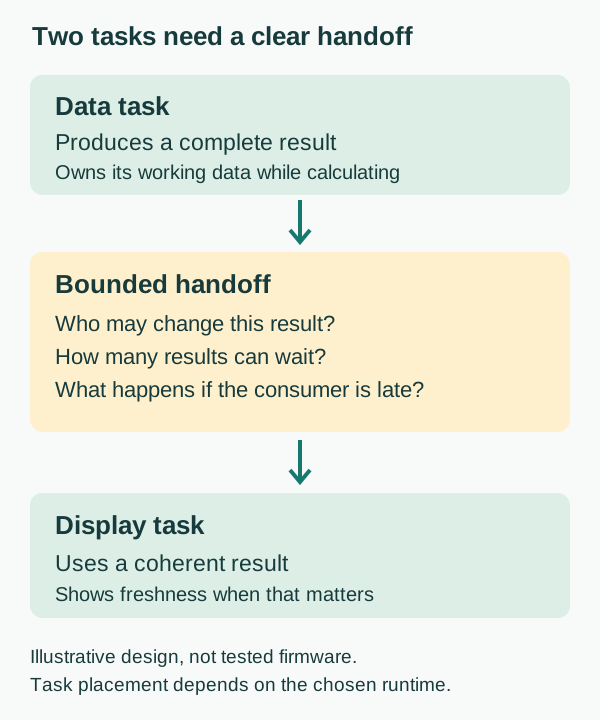
The handoff is part of the design
Imagine the data task updates a reading and its timestamp while the display task prepares a screen. If the display can see a partially updated result, it may present information that never belonged together. Agree on how a complete result becomes available and when its storage may be reused. A lock, a copied message or another synchronization mechanism may be appropriate; the choice belongs with the runtime and the data involved.
Also decide what happens when results arrive faster than they can be consumed. For a live status display, keeping the newest complete value may be acceptable. For a recorder that must retain every sample, silently replacing older results is not. This is a product requirement your engineer needs before sizing a buffer or deciding how tasks wait.
Shared peripherals need an owner too. Splitting application code across cores does not create a second physical screen interface or make a driver thread-safe. Prefer an explicit arrangement in which the task responsible for a device receives requests from other work, unless the driver and synchronization design support another approach. Test the combined arrangement rather than relying on two successful standalone demos.
Check what your software actually supports
The chip's capabilities and the firmware's programming model are different layers. MicroPython's version 1.29.0 documentation for _thread, updated August 24, 2026, still describes the module as experimental. That is a reason to verify the chosen board, firmware and libraries, not proof that every threaded application fails.
Some developers do find separate roles for both cores. In a community discussion we reviewed on October 10, 2026, one contributor described separating a timecode project's interface from the work of feeding PIO buffers. Others reported little need for a second core. These are individual accounts, not adoption statistics or timing guarantees for another product.
For your project, ask:
- which operation needs parallel execution;
- which libraries touch shared state;
- what happens when either task stops making progress.
Keep the intended firmware version in the test record. A design that depends on behavior observed in one build should not silently become a promise about every future update.
Compare the complete interaction
Use the same board, firmware and workload to compare the existing arrangement with the proposed split. Measure the response the user notices, check that results remain correct and record whether data accumulates faster than it is consumed. Include busy periods and interruptions expected in actual use. These are proposed checks; we have no such comparison to report here.
Keep the second core if the evidence shows that it solves the required problem with a handoff the team can maintain. If it merely moves the wait elsewhere, revisit the task boundary or the waiting operation. A successful outcome can be a simpler single-core design as readily as a justified dual-core one.